Intertwined hands—
Four squeezes: do-you-love-me
Three squeezes: yes-I-do
Two squeezes: how-much
Squeeeeeeeeeeeeee: (that much)
Alternating roles, my dad and I gave each other the chance to relay the depth of our love with the intensity of a squeeze. It was a reflex initiated by the joining of hands, an act as easy as breathing. This act—my small hand in his—spanned all three decades of my life. He invariably responded to my squeeze with a joyful, “Ouch!” to let me know he got the message—a squeeze of limited power but boundless love.
That was us: “I love you” with words; “I love you” with hand squeezes; “I love you” with hugs.
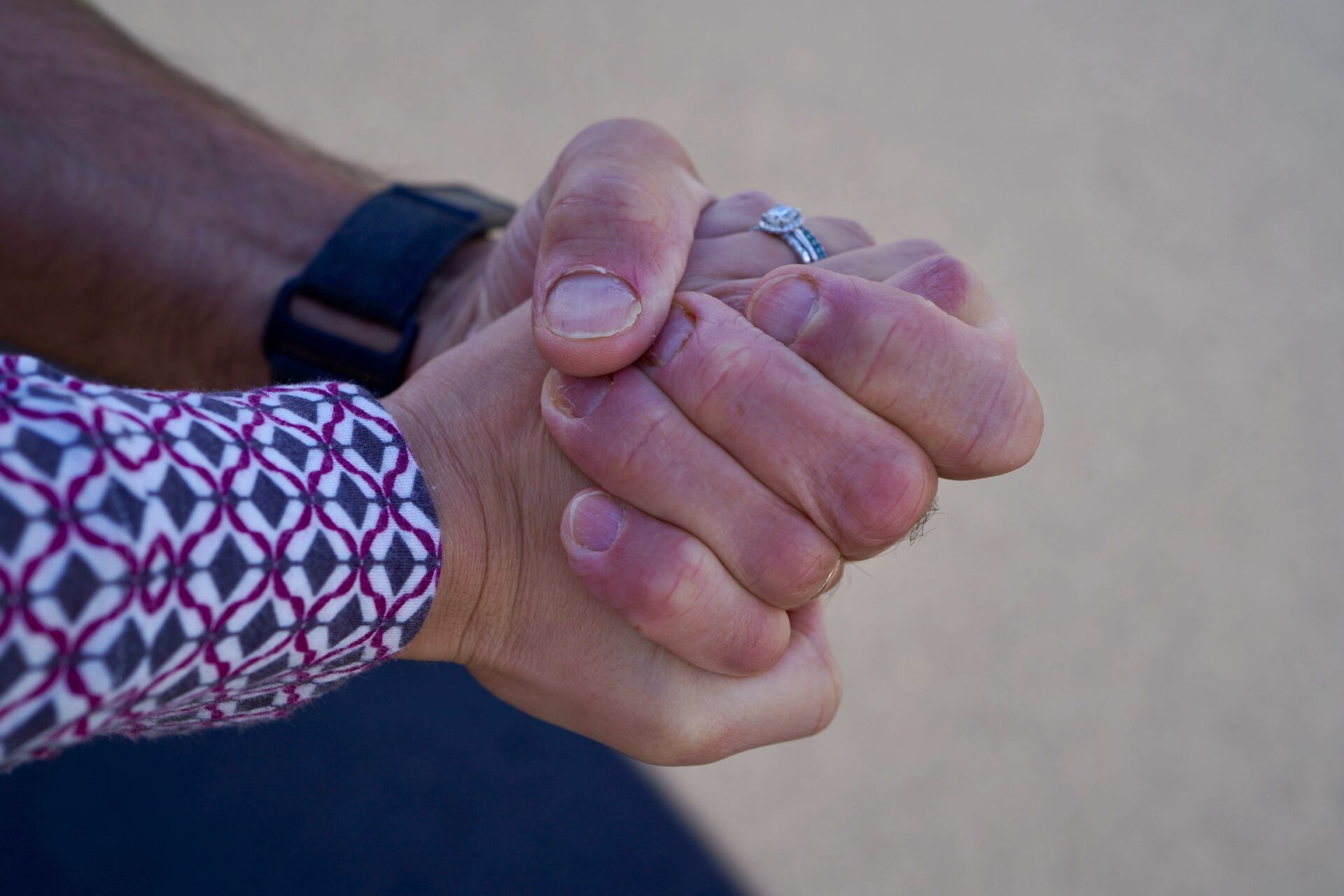
I took this picture of my dad and me intertwining hands on a balmy day in early October after a family walk along the beach. Our trips together had become more frequent ever since his ALS diagnosis that summer. He leaned his weight on me, his walker pushing to the side. As was our custom, we said a threefold, “I love you,” before we parted. Before I got into the car to return home, we shared our last full-bodied hug. Suppressing sobs, I squeezed so tightly and for such an uncomfortably long time that he, laughing, was the one to push away.
It’s a snapshot that lives free in my mind, anchoring the loss that radiated from this point for the days, weeks, and months that followed. The next month, he lost the ability to stand. Six months—the ability to squeeze my hand. Eight months—the respiratory capacity to speak. Ten months—he was dead.
In many ways, this picture captures the spirit between us, frozen in time and place, memory and capacity. Even while his body rapidly deteriorated outside of this frame, even as I saw my future shatter outside of that moment, the simple act of a father and daughter gripping hands, conveying love through sequential squeezes, became immortalized.
His hand, intertwined with mine. His fate, intertwined with mine. His loss, intertwined with mine. This picture anchors my memories, as three weeks later, I learned I had inherited his dominant genetic cause of ALS. Then the realization hit—at age 30, I had already lived half of my life.
His desire to live, intertwined with mine. The loss of precious life, despite a fervor to live, was devastatingly unfair. Accompanying my dad towards a sure death, I grieved his loss while gaining insight as to the terror that most likely awaited me. During his swift decline, I was losing him alongside my dreams for the future. The possibility of my future children meeting their grandfather, of my dad helping them navigate life’s difficulties as he had helped countless others—evaporated. The decreasing likelihood of living long enough to help my future children with their high school homework, or watch them graduate from high school and college, caused me unbearable pain. I recently cried at my friend’s wedding, mourning the pathetic odds of me ever partaking in a beloved mother-son dance or helping my children prepare for their weddings. I’ve sobbed at the near impossibility of meeting my children’s children or living long enough to have a fruitful career in medicine and research—at the mere one in twenty chance that I’ll live to retire and explore the world alongside the love of my life. The pain of all the loss, all at once, crippled me.
For over a year, I drifted. I didn’t know how to reconcile the manifold pain. I didn’t know what to make of this future that suddenly looked so different from the one I had always imagined. Being a physician-scientist seemed incompatible with fatal neurodegeneration at the height of my career. Discovering that I have a genetic predisposition to an early-onset, terminal, and untreatable disease while developing skills to cure such diseases—given enough time—seemed at first a uniquely cruel and unusual punishment.
However, the grip in this picture has recently acquired a new meaning for me. With renewed spirit, I oriented my MD-PhD career towards curing ALS. It’s a call to arms, centered around love.
In late August, unable to respire the breath of life, my dad died in my arms. Surrounded by singing, family, and community, he could not have imagined a better passing from one plane into another. I rushed to his side the evening prior after giving the final talk of my PhD, which I dedicated to him. Kneeling by his bedside, I recited this honor and my new life’s goal in his name. He was somnolent, his capacity to speak or squeeze long gone. In my dreams, our hands enact one final routine—
Four squeezes (me): You died in my arms with a will to live, even though the best of medicine had failed you.
Three squeezes (him): You’ve dedicated your life to improving the odds.
Two squeezes (me): I’ll tackle ALS…
Squeeeeeeeeeeeeee (him): You WILL.