Art by Shanthi Deivanayagam, MS1
Scenario I.
Writing is the ultimate flattening. This was the thought passing through my mind as the numbers on the screen slowly succumbed to the pull of the black hole that is zero. The gatherer of these numbers was a computer, reading impulses from myriad sensors and sticks and wires radiating from a man in bed. Earlier that morning, I had reviewed his history before heading to the room to check his brainstem reflexes. He was not an old man. He had no risk factors. His notes described him as “unfortunate,” or sometimes, “very unfortunate.” Sometimes they gave no description at all.
I wish I could have met him outside, in the world of the well. Now, he could not speak, nor move, his faculties robbed from him by an expanding brain tumor. Glioblastoma. Every time I read that word, or heard it spoken out loud, it felt like a visceral curse of the worst kind, one that would make the stoniest of residents drop their voice, up there with hearing “the B-word” whispered on a stroke service. And yet, it was also just a word, an encoding created within the electronic medical record to facilitate care delivery, a term which shared space on the problem list with skin tags and allergic rhinitis.
Besides the smell of melena and the sight of the large intestine caked with small, sallow metastases, the other sensation I will carry with me is the distinctive sound of a person who is dying. It is a nasal, foamy, gurgling noise, made with each strained breath as the body weakens and can no longer clear upper airway secretions. It is the opposite of peace and comfort. As I entered his room, the alarms and beeping struck me, but his quick, rattling breaths were something new: something sinister that penetrated my head, and reverberated. His wife, who had been by his side since my pre-rounds visit, looked at me. Her arms were around him. Her face communicated disbelief, but her eyes were replete with knowing tears.
But this couldn’t really be happening, right? How could it, in a system with shots and pills and procedures for every issue imaginable? Where new technological advancements are announced every week? How could it be, when just two hours ago I was hovering my metal thermos beneath two nozzles, deciding between Veranda Blend or French Roast? I was an alien to this kind of absolute futility. It felt like hearing the sirens of a passing fire truck while hovering over a plate of Eggs Benedict and salmon, like seeing real blood running down a knife at a haunted house. Standing across from his wife, knelt over the bed, I was split by blinding contradictions. I was an observer, and also a participant, in my life and his. My life was mundane and insignificant, and yet, I clutched onto the people and things I loved even tighter, as if passion were a shield against oblivion. I was so undeserving, and I was also right where I needed to be. I considered this feeling. For an eternal moment, our worlds coincided, our cosmic timelines in perfect synchronization. But while my story would march onward, floating blithely over commas and prepositions, his had met a final, impenetrable blot of ink.
A new light. A new alarm. My eyes turned back to the monitor, entranced by the frenzied dance of the numbers. Like stratospheric hailstones tumbling atop air currents, they continued on their inevitable descent: 30 meters down, 23 up, 40 down, 10 up, 13 down, 20 up, 32 down…
Scenario II.
Writing is absolute decay. It deludes the author into thinking they have complete control over creative expression, when in reality to write is to embalm vision, encoding it as dead symbols in a freeze-dried realm. We painstakingly form the structure of settings, characters, and ideas, as if good technique can equip our thoughts with the power to withstand the rot of eternity. But this is a fantasy. Like with life, the point of writing is for the now. Writing is a pawn which time forces over the edge of a chessboard, left to wander without the rules that once gave it meaning. Like a factory without its generator, we can prod the rusting cogs and swipe dust off decrepit machines, but we will never truly understand its living operation, how each part communicated within and without the whole. We can look at silicon engravings on a microchip, and understand their form, and maybe even reason out their function, but nowhere in the frozen artifact can you find a description of what it meant to people. That moment is gone.
Somehow, I found myself back in the hospital, back in another room. I had been called in by my resident, who with wide eyes and nods had noted in the dim workroom that this was “good learning” for me. Stationed in the corner, I studied the scene like a Rembrandt. First, the subject. From scalp electrodes sprouted multicolored wires, like the ones I used to wrestle with over breadboards in the old bioengineering building, which coalesced into a garland which sat on the head of a man. The man did not acknowledge his honor; in fact, he did not speak at all. My eyes followed the thin trails of wires as they curved downward and sat limply atop a plastic bedrail, a pylon for neural transmission. Within a monitor, each loose string relayed a jagged, digital signal, adorning the electroencephalogram with the hidden peaks and valleys of the unmoving man.
Less than eight ticks per second in the occipital chain. The epileptologist’s call: generalized background slowing. Without its fundamental rhythm to keep pace, the man’s brain struggled to respond to the outside world. This was a consequence of the physical nature of electrical systems: an appliance, when flown to Europe, will not run as smoothly when its power supply is switched from sixty oscillations per second to fifty.
But the man’s internal storms were far more dynamic than the hum of a power line. I wondered — is he stuck in the rain? Is he calm, or is he frustrated? Happy, or in despair, using the last of his energy to scream into a deaf sky? Or has he found shelter inside a mental hut, looking through a small window as drops batter the earthen gyri which imprison him?
Faced with the impossibility of understanding this existence, I closed my eyes, and I went somewhere else.
§ § §
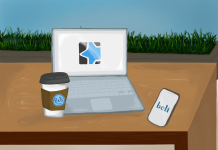
I enter a bright space with many laptops and many fashionable people taking sips of mud, indulging as if it were divine nectar. I order the cheapest brew, snag a chair, and pull out my own device, an eggshell white Asus with rainbow-lighted keys. It looks like someone stuffed Trollis into an Oreo. A deathly pale page is contained on four sides by the smooth black plastic of the laptop’s screen. I am ready. Writing and beans, beans and writing…
Every so often, I remove my headphones to listen to the people around me.
“No, no… it’s not a radio station, it’s a webstream…”
“It’s definitely the place to be.”
“Are you in the office this week?”
“I took a practice test without studying.”
“I was so drunk.”
“That’s almost a third of your salary.”
“It’s good, but the finale sucked.”
“It’s not really a problem set; I could do it in an hour.”
“Long call. I’m on long call, then short.”
“Yeah, I think it’s my new favorite PTA.”
“I’m definitely, like, in a transitional period.”
Not much for inspiration. I rub my eyes, throw my headphones on, and try to write some more.
My fingers hit the keys, which print their associated symbols in a concert on the screen. Each finger is a servo connected to an electrode which extends all the way to the motor cortex, while each command to the motor cortex is received by the visual cortex, processed by the language center, and fed through a system of associations. Somewhere in the circuit exists my writing. Yes, that’s it! The process of creation coincides with the creation itself! I wipe my mouth. A human brain smeared over an Oreo — what does the epileptologist have to say now? I pick up my cup, rocket fuel half empty. I take a swig, and I type, and type, and type, and with one final sip, I hit a resounding period with my pointer finger. I smash the cream cookie shut and shove it into my bag.
I get up to leave, but with the coffee’s effect fading, my blinders are knocked off with ease. I look around, and I feel my head start to give way from the weight. I sputter, and then finally, I stall. I feel my spirit dive toward the rocky earth.
Every screen is lit up with a prompt and a computer generated conversation. “What can I help with?” asks one. I see machines that write for machines to write for other machines. Nestled within these pawns, I am fianchettoed. Claude, ChatGPT, Gemini. A man in a vest presses Enter and smirks. “Yeah, I must have burnt down so many trees.” The prompts continue to pour out, flooding from all angles, the outputs copied and pasted to form new prompts. The eyes, half-hooded, wait for a blinking cursor to spew out an answer. I try to lift my bag. What… am I even doing anymore? My head rings with the only word that seems fitting. Doom. Like a church bell clanging with each step, we are doomed. Doom, doom, doom.
I close my eyes and dream of nothing.
The next morning, my resident waltzes into the workroom. With a pat on my shoulder, he tells me the Ativan challenge worked. The patient did not wake up screaming. Oddly enough, he woke up singing.
Scenario III.
Writing is human. Despite the limitations of the medium, it is necessary for humans to write, and not machines. The end of writing is its effect on consciousness, which itself is made up of thinking and feeling. When we ask machines to write for us, we place importance on the end product, which are not the words in the output per se, but the experience we desire: the feeling of talking to a loved one, the entertainment of a personalized story, the satisfaction of a polite and well-written work email. However, every prompt we write diminishes our ability to actually interpret information. By continuing to use such machines that produce desirable writing on demand, that sever sensations from the reasoning required to get there, we are participating in the commodification of human experience itself.
Why, then, has there been such a push for generative AI? It is not because the programmers, who are mostly new-school, bright-eyed, conscientious, and young, believe in their product. It is a result of the free market, unscrupulous by design. If the accumulation of capital happens to rub away all organic interpretation and synthesis in the process, then so be it. It is the principle of double effect in action: every time the invisible hand slides across the table to collect its dismal gain, it necessarily sands off the outermost layer of that fundamental inconvenience of existence, the final enemy of perfect efficiency: thinking. And so, we continue our march into a simulacrum, a world composed only of sensation, pawns drifting without chessboards, an existence where deeper meaning is quaint and sentimental.
“Yeah, to be honest, I never really thought about AI art too hard.”
My friend interrupts my monologue, yanking me out of a mental spiral.
“…really? Don’t you do graphics?” I ask, not entirely convinced of his blasé response.
“Mhm. But I’m more into music, anyway.”
“Fair enough.” Right, I knew that.
The air hangs low with our sighs. I sit next to my friend on a stone precipice, gingerly nursing my right ankle, the one I sprained weeks ago during my neuroradiology rotation. Silly reason — exit stairs. As I reposition my elastic support sleeve, the bitter wind of Philadelphia rushes through the dusky gardens of our heads. Then, it hushes in tasteful fermata. My anterior talofibular ligament throbs on.
Suddenly — lancing words from the left: “dude, do you have a spirit animal?”
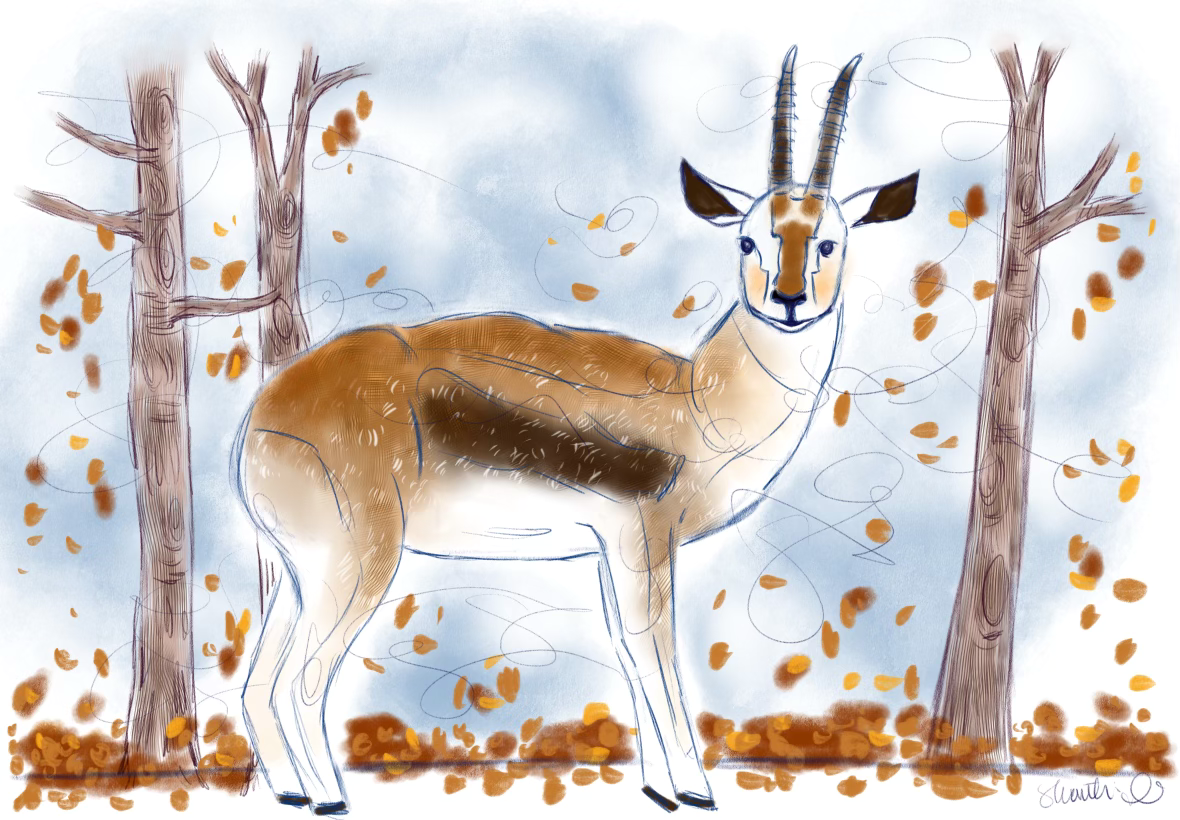
There it is. In good company, this is a question that will appear with certainty. In fact, the inescapable pull of this conversational planet has stabilized the shuttle of my life. And the answer I call home? “Gazelle.” Since high school, friends, family, and teachers alike have invariably told me, “gazelle.” “You’re a gazelle, it’s so obvious.” “You’re just so graceful, man.” “Silky soft features.” “It’s the legs.” “I mean, look at you. You’ve definitely got the face and the bone structure and stuff.”
My friend scoffs, his lips breaking free into a quivering smile.
“I dunno, it kind of sounds like an insult?”
Oh.
“Well, alright, what am I then?”
“Hmm…”
He briefly looks me over. Then, as if impressed, he narrows his eyes and nods.
“Penguin.”
I spot a violet-colored heliotrope in the corner of my eye, swaying in the wind. A small act of rebellion against the changes of fall.
“Dude. I’m not a penguin. No way.”
“Ehhh. You kinda are.”
“What, you want me to wear like… like a tux, or something?”
I grin and gesture like Fonzie, but inside, I am empty. Gazelle… I’m not a gazelle. I’m not a gazelle? Oh. Penguin. I’m a penguin…
I imagine a penguin wearing an oversized white coat, whacking someone’s knee with a reflex hammer.
“Can I at least be a macaroni penguin?”
“Nah, nah,” he cracks up and waves his hand. “Dude, you’re just a penguin.”
…just a penguin?
“Well, uh, you could be a pony!”
“A pony?! What?!”
He lies back in the woodchips. It hurts, so he quickly rebounds. I feel kind of bad.
“Ha, dude, nah, I’m just — joking, just joking. You’re like… a tiger, or wolf, or like… a lion! King of the Jungle! How’s that?”
The smile of confidence snaps back.
“Yeah… I like that, I like that.”
“Yeah.”
We marvel at some squirrels fighting under a dead tree. It’s real ugly. I didn’t know they could tumble like that.
“So, how’s your work?”
“It’s good. I mean, I’ve mainly been working on some water physics. Shaders and all of that stuff, you know.”
“Nice! That’s actually really cool.”
My mind zooms in. I fantasize about matrices, like those which underlie Mode 7 graphics on the Super Nintendo Entertainment System, the jagged, hyperdimensional worlds that once lit up my dusty dorm room, the breezy, jazz-fusion soundtrack to Pilotwings, which simultaneously inspired and lulled, and the iconic golden pendulum in the opening of Chrono Trigger — a classic and clever example of rotational transformation in Mode 7.
“Yeah. I mean, it’s fine. I don’t even really play the game though? But I do my part, and I get paid for it, so it’s all good.”
“Ah, I see. Well, whatever works, right?”
“Right.”
Nods and flattened mouths all around. After a couple seconds, he turns to look at me, eyes flitting as if I’m wearing my custom-made, stonewash, medical school Patagonia.
“You know, it’s funny, I feel like more people are switching to medicine.”
“Oh yeah?”
“Yeah. I feel like it’s the move.”
“Hm.”
His suggestion triggers a memory which consumes my vision. Now, my mind is dark. I’m in an emergency C-section. It’s just past 3 a.m., and people are beginning to shuffle out of the room. The resident passes me a needle driver. She stares at me with hooded eyes, pitying my hesitation. I blink, and her face is gone.
“…I guess so.”
“It’s just like, in tech, it’s getting harder and harder to find a job.”
“Hm. Oh yeah?”
“Dude, it’s a crapshoot! The market’s terrible. You either get lucky or get born with crazy talent — otherwise, you’re cooked. Man, it’s not like five years ago. There’s just no place for you anymore.”
“Damn.”
His words send a dry chill into the air. Realizing this, he inhales and shrugs it off.
“Yeah. I mean, it’s why I’m moving. To Sunnyvale.”
“Google, right?”
A flicker of a tooth.
“No, dude, that’s Mountain View.”
“Ah.”
Two women who were sitting near us get up and leave. The sun ticks toward the west, and the conversation enters another lull. We decide to give it a break and just enjoy the urbano-ecological scenery we came here for. Two bros and some impromptu self-reflection. I study the trees of the park. I lean off the precipice to look closer, allowing my cognitive machinery to absorb and involute in infinite regress. What a strange trunk. That one is bent, and that one was split by a lightning bolt. That one’s tiny. That one’s dead. Wait. Is that one… on fire?
The wind picks up, inflating the yellow, orange, tan, and grey alveoli of the park for a few seconds. Then, just as quickly, it drops, they stop rattling, the physiotherapy ceases, and again the lungs are still.
Lungs, I think. Lungs? Yes, lungs. My lungs, to be exact. The lungs that belong to me. And my breathing. Here, in this park, I am breathing. It feels great to breathe. The crunchy lungs are crowding around me. Yes. I suck in some autumn air. Smells like love. Smells like nothing. I breathe some more. I love that I can breathe, you know? Faster, faster, I breathe. I look up and try to breathe in the sky. The sky! My friend falls into the background. I’m breathing so much, my chest is heavy with air. For some reason, it’s hard to get out now. Now, I can’t get it out anymore.
Tension overtakes reason, blossoming through spring-loaded ribs into another memory.
I am pleading with a patient, smoke seeping out from underneath a locked bathroom door. Two police officers tower behind me. “Sir, if you don’t unlock this door, we will have to open it by force!” An annoyed voice shoots back, “I don’t know what you’re talking about — I told you! I don’t have any cigarettes!” “There are oxygen canisters in here, man! What are you gonna do if one blows up? Then what?” The haze sands my eyes and penetrates my paper-thin scrubs. The room is full of fumes and bourbon. “You’re the doc, right? Say something to him!” My head bobs up and down. I try to remember something on how to deal with “difficult” patient encounters, entering my mental palace and placing myself in front of the furrowed brows of a standardized patient, but for some reason, the only word that wants to come to my mind is “countertransference.” “C’mon, man! What are you doing?” Okay. I don’t know. The smoke is now crawling up and into my off-white sneakers. I face the old door and try to be nice. I don’t dare to knock. “Sir, is everything okay? What’s going on?” But I can’t open my mouth without everything getting in. There is a muffled reply, probably a yell, but my ears are shot. I blink, but my eyes are gone. I clear my throat, but I can barely breathe. I can barely think. Mucus and saliva squeeze my core. The patient is in there, screaming their head off. My chest burns. My heart hurts. Please, sir, please. Please just open the door!
Slowly, slowly, the vision fades, and I am released again into the park of organs. My ankle throbs, and I reach down reflexively. I take a very deep breath, followed by a sigh. It’s over for now.
I look over to the dead tree and appreciate the rot and gnarled roots. My eyes start low, then — carefully — I bring them up. I’m doing my best. Some flickers curve around the hollow trunk. One and two; they’re at it again. Like a barbershop pole. He bounds with pride, and him, with reluctance. They are separate, but each one sacrifices something without the other. Something important.
I nudge my friend. We watch as they join, warm seams obscured by passion and fur, and then together, tumble down the hill.
“Dude. You’re a squirrel.”
“You know, I could be convinced. I could be convinced.”