There are weevils in my rice.
Yes, weevils. Little crawling things. Scourge.
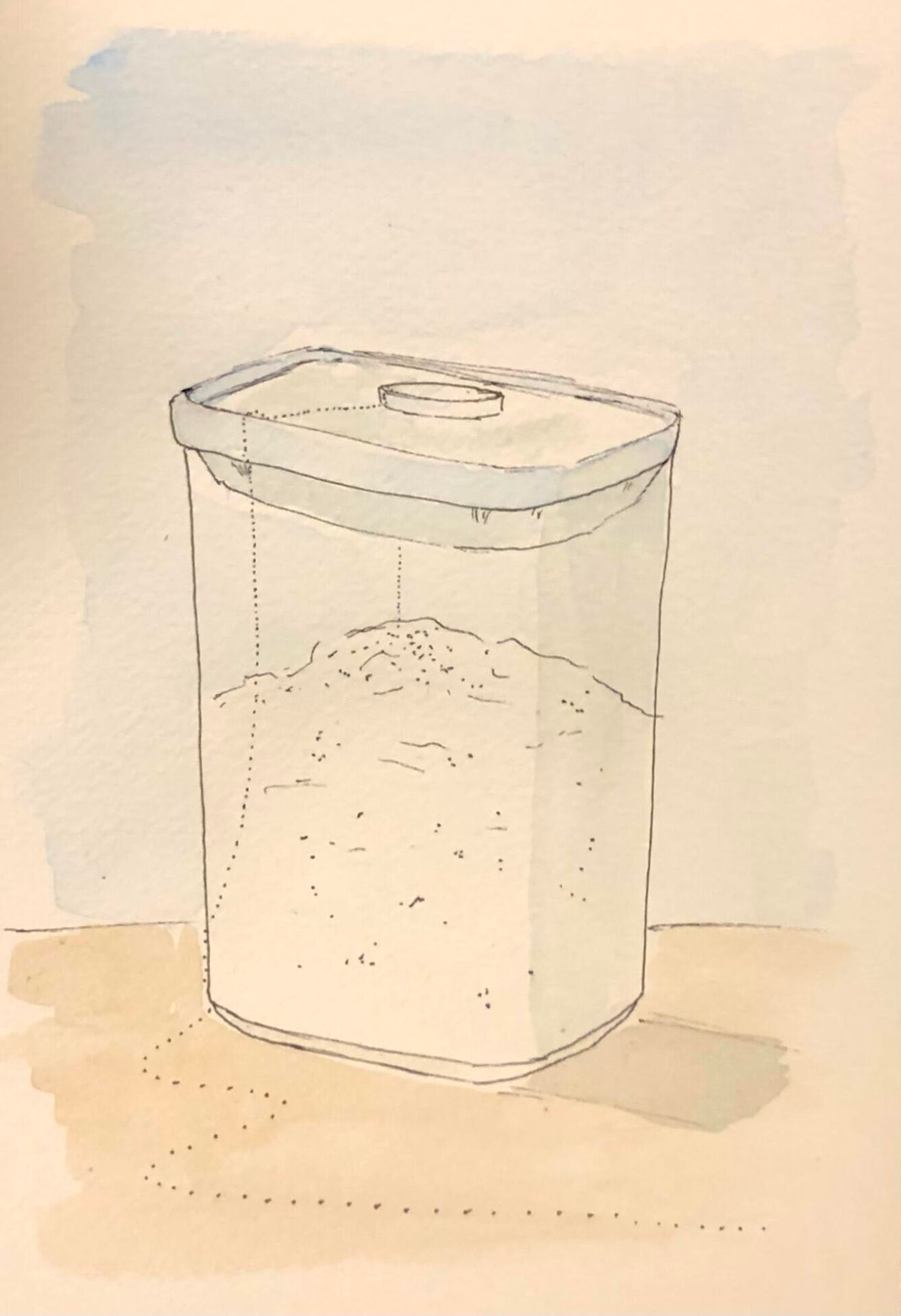
Long brown snouts and probing antennae. Through the curve of my clear, air-tight container, I watch the weevils burrow through the uncooked rice like spring water in jagged limestone. I see one crawl in a circle and then slip. Another one tumbles off a grain. The weevils disappear, swallowed by white nullity. Then, just as easily, they are reborn at the container’s horizon.
But the inputs and outputs don’t line up. One heads in, two heads come out. Five dive, and three are set free. I scoop up some rice in the measuring cup and then pour it back into the container. A pair of bugs. I try and try until it looks clean enough. I transfer ten thousand white beads into a metal pot, and I flood the pot with water. Tiny specks with shells float to the surface, and I pour them away. Again, I flood, and I pour. More specks are swept away. I continue until I can’t see any more of them. Then, like nesting dolls, the plastic container engulfs the measuring cup and the pot slides into the cooker. I hit START and the onboard piezoelectric gives a happy chirp. Fresh, fluffy stuff is on its way.
I wonder if the weevils know that their world is artificial. When they feel their feet touch grain, do they imagine the tenderness of a fern? Or do they sift through the rice and recall the elaborate, silty burrows they used to create around river deltas? When they sense the light coming from my kitchen counter’s strip LEDs, does it remind them of the noon sun as it filters through dense lemongrass?
I realize that I don’t know where rice weevils live in the wild. A quick search online tells me that they live alongside humans — in silos of corn, street market stalls, and flour-filled pantries. In fact, the only way of living they know is man-made.
Nevermind, then.
As the rice cooker sputters away, I look again into the blighted container. The subtle curve of the plastic reminds me of the lens of a telescope, or maybe an ophthalmoscope. I practice switching my focus, adjusting the scope in my head. First, I look inside deeply and concentrate on a single bug. I think about how the bug scales the edible terrain. What accounts for such precise, coordinated movements? There must be some wiring inside that acts as a control system to maintain stability, and some algorithm to determine which step to take next. Another bug walks into frame, and I zoom out. I think about the weevil’s life cycle. Life begets life begets life. The ability to create life is a function of the weevil collision rate, and the composite health of the participants in each colliding weevil pair (weevils reproduce sexually, right?). The scope flickers and takes on an iridescent tint, and now the weevil-infested jar looks like a hamfisted metaphor. It’s something like cultural disconnection, the politics of food, the paradox of youth, the fragmentation of heritage, and the like. Weevil… we evil? But there’s no time to consider that thought as the scope involutes and gives way to macro-physics. I watch and watch, but the rice sits very still. It’s brilliant how engineers designed the container such that I don’t need to interact with the rice grain-by-grain. Instead, I have the luxury of manipulating an abstraction. Through simple physical constraints, I can ignore the potential relationships that some 500,000 grains of rice would have had with the world around them, how they would be pushed by the wind, how they would fall, and roll, and bounce, and spin. Containers adjust the scope of how we interact with the objects held within. Suddenly, the number of inputs that we worry about plummets: from 500,000 little grains to a single jar you can fit right next to the tea kettle. It’s an elegant process. It’s what keeps the weevil rice from spilling all over my kitchen floor.
My mom and younger brother explode with laughter, ripping me out of my meditative state and sucking me into a dimly-lit Chinese restaurant.
“Wait, Ian, hold on, we were just kidding…” my mom said, setting her glass down. She’s tearing up. “You mean you actually washed away the weevils, and then cooked and ate the rice?”
“Um… yeah.”
“Ian, what is wrong with you?”
I smirk and shrug with misaligned eyes. Moments pass with the clinking of teacups and clacking of chopsticks.
“So, how’s the sub-I?”
The question is tossed into the mental gyre. How is the sub-I? Overall, I think I’ve enjoyed my time. But at the same time, it’s been exhausting. I feel like I’m learning more about what it’s actually like to be a doctor. I’m feeling the friction of jagged and arbitrary medical guidelines and what it’s like to translate incomplete information into life-altering decisions.
It’s a feeling that I wasn’t prepared for. Who could be prepared for this? To remain vigilant at all hours, to be asked for perfection from every angle. It’s times like these that the most human profession feels the most dehumanizing.
The table looks at me expectantly. How should I distill my feelings to my family? I feel like my khakis are too short for my legs. Should I be honest? Should I lie? Should I tell a funny story? A sad one? This is my one day off this week, and my brain is twenty seconds of sweet silence away from A&Ox0. Should I break into laughter? Should I break into tears? In this moment, all I want is to be understood. If only I could shed my writer’s voice, if only I could hand them a raw print-out of my emotions, of the unfettered output of my primary motor cortex to my fingers as they act on the mechanical switches of an imaginary keyboard, it would look something like %#GOJOAJERIAN$#IAGIBAE AWI.awWRGIPJWJ WRIGJPABNREPKG ARo4w’jAGOJ$A#POJONBBBRV O$EJAPO@P$WRGJPAG AO ARPOGJ AO AOERO AO AO AO. WO$K>
I adjust the scope.
“It’s good.”
“Oh, that’s good, that’s good.”
More eating. Then, mom looks up at me.
“You know, we’re all proud of you.”
“Thanks. I know.”
I take another bite. Honey walnut shrimp… mmm.
It’s all going to be okay.
I look through the windows of the restaurant, and it’s still bright out. Judging by the number of pedestrians and the current angle of the sun, it must be around 1 p.m., which means we just ate lunch. A memory shifts into view. In it, I push through the front doors of the dim, fluorescent hospital after a 28-hour shift, being instantly blinded by the natural radiation and shaken to life by the hums and squeaks of street machines, as if rising from the grave of the workroom to be born again. We walk to the car and get inside.
There, I ask my mom, “What did you guys do back in Singapore when you found weevils in your rice?”
“Oh, well…” she ponders for just a moment. “Back then, I think we would just wash it and eat it too. It’s not like America, you know.”
Then what was so funny about me doing that?
“The climate is different. It’s tropical,” she continues. “Weevils were everywhere. Throwing it away would just be a waste of good food.”
The sights of my ancestors pierce the car’s chassis with laser precision. I distract myself by checking my phone.
Redditors weigh in on weevils: “They’re pretty harmless.” “Return the bag.” “Extra protein!” “Just wash them out — the suckers float.” “Turn the rice into dog food.”
Okay. According to OpenEvidence, it is generally not safe to eat rice infested with weevils. Furthermore, infested rice has a significantly lower nutritional value than non-infested rice (Ndomou et al., 2024).
I open ChatGPT and ask the same question: “Weevils in my rice. What should I do?”
“Freeze the rice for at least 3-4 days to kill any weevils and their eggs.
Sun-dry the rice to drive out any remaining bugs.
Sift and rinse the rice thoroughly before cooking.”
I look at the screenshot I took. The instructions read like an overstuffed haiku. I think about how a couple of business-oriented human brains outsourced scores of underpaid human brains to train a function that could imitate a really smart human brain. Organic functions giving rise to an artificial one. And now, the artificial function is influencing my brain. An artificial function influencing organic ones.
Dinnertime. I squint at my shrimp fried rice. No funny brown dots with feelers. No moving specks of pepper. No decay. It’s still good. I place the spoon into my mouth. I swallow.
The grains of rice fill me with uncertainty. I can’t be certain exactly how each grain tumbles down the lumen, how the acid etches away at the starch, whether a grain decides to enter the miniature whirlpool developing in my pylorus. I also don’t know if I’ve swallowed a cooked weevil. But that’s okay. I don’t know because it does not matter. Likewise, it does not matter because I have no way of knowing.
What matters is the terrain around me. The rice cooker. The table. The door handle. The rickety chair in the corner of my room. The good design of the world. The artificial grains that form my habitat.
With each scientific advancement, we are able to better harness the processes we cannot comprehend. Just as how the curved plastic holds the rice in, my computer holds the states of countless electrons, manipulating them with a speed and precision beyond my understanding. The miraculous result is the video playing in front of me.
I remember that I still have a draft to finish. These days, writing has become a cherished refuge from the regiments of the hospital. I hit pause and switch tabs to a document filled with markup. The monitor glows white, and I quickly scroll down to read the last paragraph on the page. Last night’s thoughts beam back, but nothing I wrote seems to make sense anymore. It’s like reading an ingredients list in a funhouse mirror. I whip out the scalpel. I write, revise, cut, join, and trim, attempting to transfigure this poor narrator into something that feels more like me. I continue with the operation, but as the night deepens outside my window, I realize that I’m getting nowhere. The piece is still too long-winded. Too sharp and fragmented. Too many conflicting ideas. Too abstract. Too antithetical to voice and flow. I’ve sculpted my own effigy out of unprocessed quartz.
Maybe AI could help me to express myself more clearly? If I could tap into the collective writing prowess of humankind to lend me a voice, then would I be better understood? It’s getting late, so I give it a try.
“I’m trying to write a piece for the literary magazine. Can you suggest some edits?”
The AI’s output coats the page in an instant. It reads a lot better. I notice that it weeded out the abnormal vocabulary and smoothed over the transitions. It excised the redundancy. It offered metaphors and imagery to try. The letters that fill the page have been pre-packaged into words, neatly tied together for human consumption. It’s all automatic. The individual grains are gone, subsumed into something greater.
The output is excellent, and yet, I despair. The AI has given me a voice to use, but I no longer recognize it as my own.
I throw my head back. A full minute passes, and then I open my eyes. I’m looking straight up. Relaxing my eyes, I imagine that the eggshell-colored ceiling of my kitchen is a sheet of paper. I blink, and now the sheet is festooned with strings of pitch-black letters which extend from margin to margin. The serifs sprout and crystallize into a dense, ornate palace gate. I scan between the bars. Through a forest of metaphors, I search for the eyes of a reader, any evidence that the story of my life connects to something outside of the page. I don’t see anyone.
“HEY!” I shout into an incomprehensible reality.
No response.
“I think that medicine is hard, but you’re sticking with it, y’know?”
Silence.
“Look, you did the sub-I! And you survived!”
…
“And you know what, that’s something.”
A few distant horns sound out from the city. Then, nothing.
There’s really nothing out there.
I sit up. I’m at the wooden table again, alone with my laptop. My draft stares back at me.
An inordinate amount of time passes. Then, I take a deep breath, almost a sigh.
I walk around the kitchen counter and past the trash can. I open the door of my freezer and take the container of uncooked rice off of the top shelf. It’s still half full. Along the edges, I notice that the weevils are no longer moving. I hold everything at arm’s length over the trash can and carefully pop off the lid.
I invert.
Down goes grain number 1. Then, grain number 2. Grain number 3 takes a peculiar path, as the microcurrents in my kitchen’s atmosphere impart it a moment about a vertical axis: north, north-north-east, north-east, east-north-east, north-east, north-north-east, and swiftly again to north. Grain number 4 shoots straight down, like a dagger into felt at poker night gone wrong, and grain number 5 is an unfortunate onlooker. A bug that looks like a chia seed. Grain number 6 is as big as a coffee bean, and it…
I adjust the scope.
It’s impossible to capture all of the details. It’s even more impossible to explain how these details should be interpreted. I strain my eyes. I try to encode the movements of each grain. I try to match these visual patterns to concepts, and match these concepts to vignettes stored in memory, and tie these vignettes to strings, and collate these strings into writing. Through the rushing cascade, the computer looks back, observing my toil. I shut my eyes. What is the point? With a single click, a prompt explodes into an essay. Art is automated. Edits are instantaneous. Meaning is obsolete. Capital is paramount. We’ve trained a machine to translate any set of inputs into any set of outputs. A universal catch-all function for everything humans care about. One step closer to singularity. Rice falling neatly from one container into another, forever.
I adjust the scope again.
And yet, I feel better. I open my eyes and place the empty container into the sink. The room is quiet again, filled with nothing but the cries of faraway cranes. The meal-prepped fried rice moves within my gut, flipping and churning in unknowable ways. I massage my core. There goes the last of them, for now.
As I cinch the neck of the garbage bag tight, a tiny light from the eastern wall penetrates the darkness. I recognize it as the oven’s clock. In emerald green, it reads “1:00” — six hours until morning clinic.
The laptop blinks off. Wearing the smallest of smiles, I turn, heft the bag, and head out.