A traveler standing in the town of Epidaurus in the Peloponnesian peninsula of southern Greece, about 80 miles southwest of Athens, would see the famous Theater of Epidaurus rising on the western slopes of the Cynortion Mountain. Constructed between the fourth and third centuries BCE, the theater is a marvel of Hellenistic engineering. Taking inspiration from the organic theater designs intended for Euripidean tragedies, the theater’s architects further developed its harmonious proportions to construct a stage that balanced aesthetic sophistication with acoustic refinement. In fact, the theater was so renowned in its day that Pausanias, the Greek geographer who authored the travel guide Description of Greece, praised the structure for its symmetry and beauty. He even deemed it superior to the theaters in Rome or Megalopolis.
In addition to dramas, performances included music, singing, and games. But for what purpose were these libations offered? One would have to travel about a half mile inland to the northwest to arrive at the Sanctuary of Asclepius. Indeed, the celebrations held at the theater were in worship of Asclepius, son of Apollo, god of prophecy and medicine. In the following section, Pausanias describes the healing of a Roman senator named Antoninus, who constructed a bath dedicated to Asclepius as well as other buildings devoted to healing, so that “the sick [of Epidaurus]” could “breathe their last in the open. . . . Here was a place in which without sin a human being could die and a woman be delivered.” Our traveler proceeds to note that sacred to this sanctuary and its deity are serpents, of a “peculiar kind of a yellowish color . . . tame with men.” He is careful to differentiate these serpents from others found elsewhere in the Mediterranean, noting that these serpents in Epidaurus are unique and a manifestation of Asclepius’s divinity. We will explore the Sanctuary of Asclepius, its function, and its healing rites in more detail, but from this brief description of Epidaurus, medicine, healing, and religion were closely linked in Ancient Greece.
This synergistic approach to medicine and religion challenges the traditional view that Ancient Greece was the birthplace of medicine, where humans divested themselves of magic and religion in favor of rational observation and scientific inquiry. Much of the literature has perpetuated this mythology of a linear enlightenment. Kaba and Sooriakumaran in “The Evolution of the Doctor–Patient Relationship” write, “Greeks developed ‘empirico–rational approach,’ such that they relied ever more on naturalistic observation, enhanced by practical trial and error experience, abandoning magical and religious justifications.” Similarly, the National Library of Medicine’s section on “Ancient Greek Medicine” also states, “Hippocrates is generally credited with turning away from divine notions of medicine and using observation of the body as a basis for medical knowledge.”
It is naïve and reductive to view the development of medicine as a simple transition from religion to rationalism around the fourth century BCE. Overlooking the continued interplay between religion and medicine ignores fundamental motifs that shaped not only medical practices but also the broader philosophical and cultural dynamics of the Hellenic world. Rather than developing as an independent discipline rooted solely in rationalism and logic, medicine in Classical Antiquity remained deeply intertwined with religion.
Herein, we shall palpate the pulse of medicine and religion at focal points throughout the Hellenic world—from the mythological origins in Homer, to the polemics of the Hippocratic texts, and the enduring influence of the Cult of Asclepius.
Sing, O Goddess: Homeric Conceptions of Disease and Healing
Thus begins Homer’s epic Iliad, which recounts the culmination of the ten-year war between the Greeks and the Trojans, an oral tradition that likely originated sometime in 1200 BCE. The opening lines describe the Greek armies at an impasse because of Apollo, “who in anger at [Agamemnon, a Greek chieftain], drove the foul pestilence along the host.” Agamemnon had claimed Chryseis, daughter of the Trojan priest of Apollo Chryses, as concubine. In retribution, the priest prayed to his patron deity to take vengeance on the Greeks. Apollo is described as one who “strikes from afar.” In the context of the pestilence spreading in the Greek camps, this portrayal emphasizes an anthropomorphic understanding of disease: plague is depicted as a physical force, as if the archer god were drawing his bow and loosing arrows of illness upon the Greeks. Here, Apollo is cast as a divine cause of the plague, which is not a random calamity, but a punishment inflicted in response to moral transgression. As Williams notes, the Greek term used in this passage is νόυσος (nousos), which translates to disease, but more interestingly, outrage or injury, both terms that intimate moral or religious undertones. As such, a religious problem requires a religious solution. The Greeks consult not the healers, but rather, the seer Kalchas. The seer declares that Apollo will continue to “send griefs . . . and will send them still, nor sooner thrust back the shameful plague from the Danaans [Greeks] until we give the glancing-eyed girl back to her father without price, without ransom, and lead also a blessed hecatomb to Chryses.” The crisis is finally resolved when Agamemnon returns the priest’s daughter. This incident highlights the ritual action and moral behavior to appease the gods, and the absence of any conventional medical authority or treatment indicates that healing in the Ancient Greek world was not purely a medical pursuit but a deeply religious affair.
However, does that mean conventional healers and medicines were absent in Homer’s Iliad, leaving religious healing as the only recourse? Absolutely not. Following a duel with a Trojan archer, Menelaus, another Greek chieftain, suffers an arrow injury to his abdomen. Agamemnon consoles him, stating, “The physician will handle the wound and apply over it healing salves, by which he can put an end to the black pains.” He then bids his herald to fetch “Machaon, a man who is son of Asclepius and a blameless physician.” When Machaon arrives, “He pulled the arrow forth . . . and as it was pulled out the sharp barbs were broken backwards. . . . He slipped open the war belt then and the flap beneath it. . . . But when he saw the wound where the bitter arrow was driven, he sucked the blood and in skill laid healing medicines on it.” Here, Machaon adopts the role of the conventional healer and tends to the wound with a combination of procedures and medicines. Homer’s detailed description of medical interventions reflects a sound technical understanding of wound care, complete with foreign object removal, wound cleansing, and pharmacology. Also notable is the description of Machaon as being skilled (εἰδὼς, eidōs) as he dresses the wound. Rather than hastily assembling a makeshift assortment of available remedies, Machaon in his actions is measured, practiced, and methodical, suggesting that even as early as 1200 BCE, there existed an empirical understanding of medical interventions. Marketos and Androutsos go one step further and remark, “Despite the frequent references of Iliad to gods and prayers of the dying, it is clear that medicine in the time of Homer was not based on magic, but was an independent discipline practi[c]ed by experts who earned a living from it.” In fact, the term for physician in this passage is ἰητὴρ (ieter), which Gonzales notes is an old Ionic form (and root of iatrogenic) that “could designate a doctor or surgeon by 800 BCE [when Homer was active] at least and likely much earlier.” Indeed, as early as the mythological times of the Trojan War, healing was a multifaceted practice that incorporated religious rites conducted by seers and priests with the technical arts performed by ieters and physicians.
Nature and Divinity: Pre-Socratic Philosophy and the Polemics of the Hippocratic Corpus
A few centuries following Homer, around the late sixth to fifth century BCE, a new movement in philosophical discourse stirred. Although only fragmentary evidence remains in the form of references made by other authors, this group of thinkers, the Pre-Socratic philosophers, took an interest in etiology and nature. To understand the Hippocratic texts, we must first understand the intellectual groundwork set by these philosophers. Chief among them were the Milesians, notably Thales of Miletus, who was famous for claiming that all matter arose from water, and accordingly, the earth rests on water. Others like Anaximander were interested in zoogony and anthropogony. He proposed that the “first living creatures were born in moisture . . . that there arose from heated water and earth either fish or creatures very like fish; in these man grew, in the form of embryos.” Lloyd considers this group of philosophers innovators in two respects. First, they sought naturalistic explanations for phenomena such as earthquakes and lightning traditionally attributed to the gods. Second, they regarded the fundamental principles of the world’s origin as divine, thereby “putting forward a new or ‘reformed’ theology.” It is tempting to conclude that these philosophers’ pursuit of naturalistic explanations marked a transition from religion to science and rationalism. However, as Ferngren observes, although the Pre-Socratic philosophers may reject “the direct interference of the gods in the natural order,” they “regard every natural event as divine.” Rather than outright rejecting religion, the Pre-Socratic philosophers redefined divinity and religion as concepts in tension with and in reaction to philosophical inquiries into nature. In fact, Lloyd notes, “it was perfectly possible to combine engaging in inquiries concerning the ‘nature’ of various phenomena with adherence to such beliefs as that diseases could be brought about by the gods.” He further observes that the philosophical inquiries of this time were an effort to generalize the understanding of nature—φύσις (physis)—as it applies to all things. Already, in the Homeric epics, explanations of nature already existed for particular phenomena, such as when the god Hermes explains the physis of a plant to Odysseus. As such, religion inspired research into nature.
Although the gods are no longer directly responsible for causing natural events, this does not negate their presence or power; their divinity was thought to manifest differently. Prodicus of Ceos is said to have accounted for “beliefs in the gods in terms of man’s gratitude for the benefit he derives from such things as bread, water, wine, and fire.” Apollo is perhaps no longer striking directly from afar, but the natural forces he represents—light, healing, and plague—remain deeply embedded in the Greek understanding of the world. Although the Pre-Socratic thinkers sought to rationalize nature, they did not divorce it from the divine. Instead, they reconfigured these concepts of the sacred within a framework of systematic inquiry.
It was within this intellectual milieu that the Hippocratic texts took their inspiration. This heterogeneous collection of approximately sixty texts bears the name of Hippocrates of Cos, a physician who was likely a contemporary of Socrates in the fourth century BCE and whose family claimed descent from the god Asclepius. Although tradition maintains that Hippocrates acquired his medical knowledge from texts housed in the Temple of Asclepius at Cos, the Hippocratic Corpus was likely first compiled in the Library of Alexandria. As Nutton remarks, “establishing which, if any, of the surviving Greek texts was actually the work of Hippocrates himself is, as has already been suggested, a difficult, if not an impossible, task, and scholars continue to disagree, as they have done since Antiquity.” Thus, the literature acknowledges that the Hippocratic Corpus, with its internally conflicting texts, was authored by multiple writers. Nevertheless, despite their heterogeneity, many of these texts in their diction and syntax reveal clear influences of rhetoric and polemic on medical discourse. In his essay “Rhetoric and Medicine in the Hippocratic Corpus,” Jouanna notes that one of the treatises, The Art, was a formal defense of medicine through polemical invective against its critics. He also highlights the frequent use of first-person verbs related to speaking or affirmation, particularly the verb φημί (phēmi, I say). While seemingly redundant, these verbs are critical in shaping the rhetorical nature of these texts, reinforcing the idea that they are not only technical discussions of disease and health, but also philosophical arguments in both form and intent. This rhetorical dimension is particularly evident in On the Sacred Disease, where the author explicitly challenges divine explanations of epilepsy through polemical critique.
Curing the Sacred: Epilepsy, Rhetoric, and the Gods
One of the most renowned Hippocratic texts is On the Sacred Disease, in which the author condemns those who attribute epilepsy to divine causes and presents a naturalistic explanation of the disease. Although it is often cited as a rejection of religion in favor of rationalism, a close reading reveals the author’s nuanced stance on the tension between nature and religion in the context of disease and healing. The text opens with “I do not believe that the ‘Sacred Disease’ is any more divine or sacred than any other disease but, on the contrary, has specific characteristics and a definite cause.” The Greek term for characteristic, better translated as nature, φύσις (physis), is the same as that which intrigued the Pre-Socratic philosophers. Like his predecessors, the author of On the Sacred Disease is interested in expanding the inquiry of physis to the general case. The litotic negation of “not . . . any more divine” implies not a direct rejection of divinity, wherein no diseases are divine, but rather, the belief that all diseases are equally divine. As Lloyd observes, for the author, “the whole of nature is divine, but that idea does not imply or allow any exceptions to the rule that natural effects are the result of natural causes.” Edelstein in his seminal work “Greek Medicine in its Relation to Religion and Magic,” further claims, “In the Hippocratic writings, one cannot possibly interpret all the natural terms as devoid of any religious meaning.” Like the Pre-Socratic philosophers, the author of On the Sacred Disease rejects the direct interference of the gods on human bodies; however, he does not dismiss divinity in healing. Rather, the idea of gods and divinity in healing shifts toward a more metaphysical interpretation. In fact, as the author dismantles his opponent’s claims, he takes affront to his opponents who claim this disease is more sacred than the others. He writes:
Those who first called this disease ‘sacred’ were the sort of people we now call witch-doctors, faith-healers, quacks and charlatans. These are exactly the people who pretend to be very pious and to be particularly wise. . . . By such claims and trickery, these practitioners pretend a deeper knowledge than is given to others; with their prescriptions of ‘sanctifications’ and ‘purifications’, their patter about divine visitation and possession by devils, they seek to deceive. And yet I believe that all these professions of piety are really more like impiety and a denial of the existence of the gods, and all their religion and talk of divine visitation is an impious fraud.
By leveraging claims of hypocrisy and impiety against his opponents, the author exploits these practitioners’ claims against them: by falsely claiming the special divinity in this disease, these practitioners exhibit unchecked hubris in attempting to subjugate the gods and their divinity to prosaic motives of increasing profit. The author makes a clever counter argument: these practitioners and their nonsensical cures expose one of three equally damning and impious beliefs. Either they do not believe gods exist (hence the need for these remedies), they see the gods are powerless to stop the disease, or they view the gods are malevolent beings who deliberately cause suffering. The author then presents his proposed theory of the pathophysiology and treatment of the disease. He concludes that the root of the disease lies not in selective divine wrath but in natural processes akin to other illnesses. These forces—“cold and the sun, the changing and inconstant wind”—are themselves divine, with “each ha[ving] its own nature and character, and there is nothing in any disease that is unintelligible or which is insusceptible to treatment.” Hence, On the Sacred Disease neither banishes the gods from medicine nor denies divinity in nature. Rather, it undercuts the belief that a supernatural explanation can be privileged over systematic understanding of bodily processes. By emphasizing that all diseases share the same divine origins and natural causes, the author recasts epilepsy as part of a broader, naturalistic framework in which divinity assumes a metaphysical role and systematic inquiry into health and disease remains compatible with religious devotion.
Of Dreams, Serpents, and Cures
Beyond the theoretical musings of philosophers and the technical treatises of physicians, we now turn to examine an instance of how a layperson in the Hellenic world might experience healing, medicine, and religion. Although the Sanctuary of Asclepius was built around the early fourth century BCE, Asclepius was known to the Greeks as a “healing god par excellence” far earlier than that. In the Iliad, Asclepius was referenced as the father of the healer–surgeon Machaon. The first detailed mythology of Asclepius appears in the lyric poet Pindar’s Third Pythian Ode, which was composed in the late fifth century. Born to Apollo and his mortal lover, Asclepius was rescued by his father from his mother’s funeral pyre before birth. He was then raised by the centaur Chiron, who taught him the art of medicine and healing, and he treated the sick with potions, incantations, wound care, and surgeries. Yet, following his attempt to resurrect the dead, he was struck down by Zeus’s thunderbolt and posthumously attained apotheosis.
By the late fifth century BCE, the Cult of Asclepius amassed popularity and wealth, likely due to a combination of official state backing by the Delphic Oracle and the aftermath of the Athenian Plague. The best-preserved evidence of the healing rites that occurred at the sanctuaries of Asclepius comes from Epidaurus, where tablets containing inscriptions of the god’s successes in healing were discovered. This collection of approximately 70 tablets, called ἰάματα (iamata, remedies), was hung on the walls of the sanctuary and served as visual testimonies of the god’s powers. Interestingly, Wicckiser notes that the god specialized in chronic conditions that eluded physicians. She describes an inscription about Antikrates of Knidos, who suffered a spear injury to both eyes, leaving him blind with the spearhead still embedded. He came to the sanctuary, and in his sleep, he envisioned the god removing the speartip and returning his pupils. The next morning, he left with his sight restored. Other ailments, including insomnia, gout, and parasitic infections, were cured similarly through incubation. Patients would sleep in the sanctuary and experience dreams in which Asclepius either healed them directly or prescribed treatment instructions.
Another method of healing involved sacred animals, notably, serpents. One such case involved a man with a toe wound. During the night, as he was sleeping, a snake appeared from the innermost sanctum of the temple, licked his wound, and healed his toe. It then vanished into the temple’s depths. The next morning, the man stated he had dreamed of a youth who applied medication to his toe, confirming the connection between his physical healing and divine vision. The Roman grammarian Festus reinforces the symbolism of sacred serpents as an extension of Asclepius’s divinity. He notes, “They are called serpents from derkesthai, which means to see, for they are reputed to have very keen vision. . . . They are given as attributes to Asclepius because they are thought to be of a most watchful kind, a quality particularly requisite to the medical art.” This emphasis on observation, precision, and skill as divine traits suggests that the god’s actions were not supernatural in the sense of defying medicine but rather embodied its highest ideals and its very nature.
Thus, while the rituals at the Sanctuary of Asclepius may appear mystical to modern readers, a closer examination of the literary and material evidence suggests that these healing rites operated within a framework consistent with medical practice. The god did not act as an omnipotent miracle-worker, but as a divine physician, whose methods—removing foreign objects, performing surgery, and applying medicinal therapies—mirrored the techniques of mortal healers like Machaon and the physicians of the Hippocratic tradition. Rather than existing in opposition to “rational” or “naturalistic” medicine, the Cult of Asclepius complemented and extended medical practice, particularly in cases where human physicians had failed. The sanctuary at Epidaurus represents a distillation of the interaction between faith and empirical healing in Ancient Greece, where religion and medicine were not mutually exclusive, but deeply intertwined in both theory and experience.
Conclusion
The relationship between medicine and religion in Ancient Greece was far from a simple progression from divine intervention to rational inquiry. Instead, both exist in a tense equilibrium, affecting and reacting to changes in each other. From the plague-stricken Greek army in The Iliad, where disease was perceived as divine punishment, to the surgical expertise of Machaon and the rhetorical polemics of the Hippocratic Corpus, healing and medicine must be understood within a broader spiritual and philosophical context. The Sanctuary of Asclepius epitomizes this interplay. While Asclepius was venerated through rituals, his actions mirrored those of mortal physicians, treating patients through surgical intervention, pharmacology, and observation, suggesting that Hellenic society did not view medicine and religion as opposing forces, but as threads woven together within the fabric of disease and health.
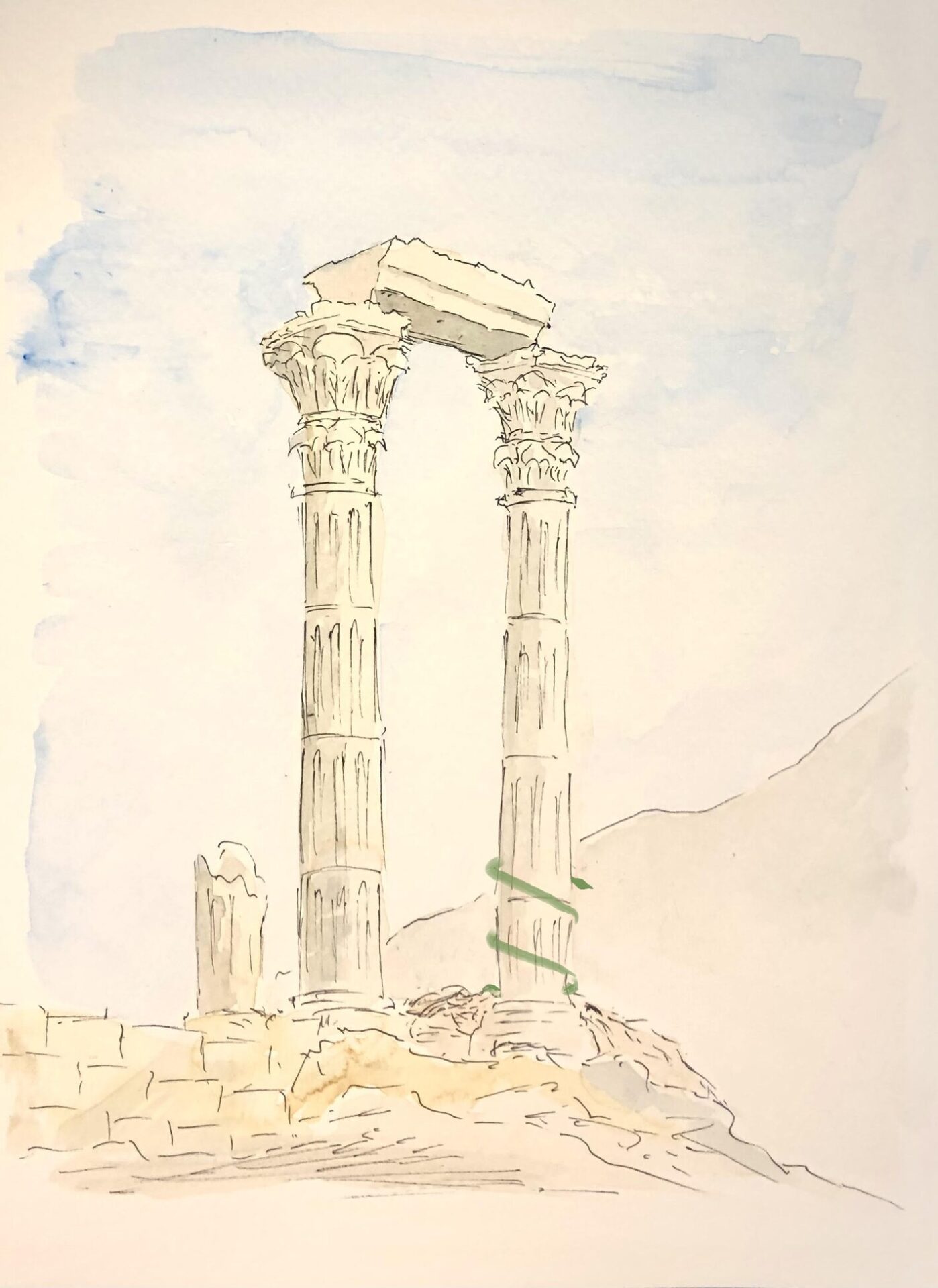
Just as the serpent coils around Asclepius’s rod, embodying the art and nature of healing, so too are medicine and religion in Ancient Greece inextricably intertwined.
References
Boardman, John, ed. The Oxford History of Classical Art. Oxford: Oxford University Press, 1997.
Edelstein, Emma, and Ludwig Edelstein. Asclepius. A Collection and Interpretation of the Testimonies. Johns Hopkins University Press, 1945. https://doi.org/10.1515/9783110816754.214.
Edelstein, Ludwig. “Greek Medicine in Its Relation to Religion and Magic.” Bulletin of the Institute of the History of Medicine 5, no. 3 (1937): 201–46. https://www.jstor.org/stable/44438180.
Ferngren, Gary B. Medicine and Religion. Johns Hopkins University Press, 2014. https://doi.org/10.56021/9781421412153.
Festus, Sextus Pompeius. De Verborum Significatione, n.d.
Gonzales, Matthew. “Magic and Religion in Military Medicine of Classical Greece.” In Archaic and Classical Greece, by Matthew Dillon, Christopher Matthew, and Michael Schmitz. Yorkshire: Pen & Sword Military, 2020.
“Greek Medicine.” Exhibitions. U.S. National Library of Medicine, 2024. https://www.nlm.nih.gov/hmd/topics/greek-medicine/index.html.
Herodotus. Histories. Translated by A.D. Godley. Cambridge, Mass. : London : Harvard University Press ; W. Heinemann, 1931.
Hippocrates. “On the Sacred Disease.” In Hippocratic Writings, edited by G. Lloyd, translated by I. M. Lonie, J. Chadwick, and W. N. Mann ; E. T. Withington ;, New Ed edition. Penguin, 2005.
Homer. The Iliad of Homer. Translated by Richmond Lattimore. Illustrated edition. Chicago London: University of Chicago Press, 2011.
Hornblower, Simon, Antony Spawforth, Esther Eidinow, Simon Hornblower, Antony Spawforth, and Esther Eidinow, eds. The Oxford Classical Dictionary. Fourth Edition, Fourth Edition. Oxford, New York: Oxford University Press, 2012.
Jouanna, Jacques. “Rhetoric and Medicine in the Hippocratic Corpus. A Contribution to the History of Rhetoric In the Fifth Century.” In Greek Medicine from Hippocrates to Galen. Brill, 2012. https://brill.com/display/title/20068.
Kaba, R., and P. Sooriakumaran. “The Evolution of the Doctor-Patient Relationship.” International Journal of Surgery 5, no. 1 (February 2007): 57–65. https://doi.org/10.1016/j.ijsu.2006.01.005.
Kirk, G. S., J. E. Raven, and M. Schofield. The Presocratic Philosophers: A Critical History with a Selection of Texts. Cambridge University Press, 1983. https://doi.org/10.1017/CBO9780511813375.
Lloyd, Geoffrey Ernest Richard. Magic, Reason, and Experience: Studies in the Origins and Development of Greek Science. Hackett Publishing, 1999.
Marketos, S. G., and G. J. Androutsos. “The Healing Art in the Iliad.” In Science and Technology in Homeric Epics, edited by S. A. Paipetis, 6:275–81. History of Mechanism and Machine Science. Dordrecht: Springer Netherlands, 2009. https://doi.org/10.1007/978-1-4020-8784-4_20.
Nutton, Vivian. Ancient Medicine. 2nd edition. London: Routledge, 2012.
Pausanias. Description of Greece, Volume II. Translated by W.H.S. Jones and H.A. Ormerod, n.d. https://www.loebclassics.com/view/LCL188/1926/volume.xml.
Pindar. “Pythian Ode.” In Olympian Odes. Pythian Odes, translated by Jeffrey Henderson, n.d. https://www.loebclassics.com/view/LCL056/1997/volume.xml.
R. J. Hankinson. “Magic, Religion and Science: Divine and Human in the Hippocratic Corpus.” Apeiron 31, no. 1 (March 1, 1998): 1–34. https://doi.org/10.1515/APEIRON.1998.31.1.1.
Vecchio, Ignazio, Cristina Tornali, Luigi Rampello, Gaetana Silvia Rigo, Liborio Rampello, Marcello Migliore, Pietro Castellino, Renato Malta, and Giuseppe Armocida. “Between ‘Science’ and Magic: Pre-Hippocratic Greek Origins of Medicine and Surgery.” Acta Medica Mediterranea 29 (2013): 263–67.
Wickkiser, Bronwen L. “Asklepios and His Colleagues: Doctors and Divine Healers.” In Asklepios, Medicine, and the Politics of Healing in Fifth-Century Greece. Johns Hopkins University Press, 2009. https://doi.org/10.56021/9780801895067.
Williams, Rowan. “Plague as Metaphor.” In Plagues, edited by Jonathan L. Heeney and Sven Friedemann, 196–212. Darwin College Lectures. Cambridge: Cambridge University Press, 2017. https://doi.org/10.1017/9781108147910.011.