Dr. Ken Ginsburg is a pediatrician specializing in Adolescent Medicine at the Children’s Hospital of Philadelphia, a Professor of Pediatrics at Penn, and the Director of Health Services at Covenant House Pennsylvania, a shelter that serves youth experiencing homelessness and human trafficking in Philadelphia. An acclaimed physician, educator, researcher and author, Dr. Ginsburg has for many years delivered the keynote speech during Penn Medicine’s orientation week for new students. His speech takes place just hours before the white coat ceremony that inducts each new class into the medical school, a timing that suggests his words about humanistic, strength-based approaches to medicine reflect the most salient message Penn believes its future doctors should hear before starting their training. We had the opportunity to sit down with Dr. Ginsburg and speak to him about this message, his work at Covenant House, and his reflections on this issue’s theme of spirit.
Interview has been lightly edited for clarity and length.
Tanya Kurnootala: Thank you for being here with us today, Dr. Ginsburg. The theme of our magazine this semester is Spirit. We were thinking about all of the changes, both politically and culturally, that’s been happening in the world. So we’re collecting ideas on what spirit means to individuals in the Penn community.
Ken Ginsburg: So glad you’re calling me for Spirit and not Enigma.
TK: I think you’re perfect for it.
Shruthi Nyshadham: Is there anything that jumps out to you immediately on the theme of spirit in medicine?
KG: Spirit, for me, leads to why we do what we do. If we’re going to be exposed to any kind of medical practice, we are setting ourselves up to be exposed to, quite literally, the most passionate themes of human existence. It doesn’t matter what kind of doctor you’re going to be. When we approach this from a place where it’s really aligned with our sense of mission or purpose, that to me is spirit.
I can bring my mission or my vision anywhere, but when I have the privilege to work in a place like Covenant House, where I am working with people who have been denigrated and marginalized by society, where some of their identities are literally being erased by society, I can serve them with loving kindness and bring out the best in them. That is mission aligned for me.
TK: You mentioned Covenant House. I know you’ve been with and influenced the organization for a very long time. How has the setting of Covenant House, with it being specifically a place for youth who have been placed at risk, changed you as a physician?
KG: So profoundly and deeply that it would be almost impossible to exaggerate. I began my career at Covenant House as a medical student 40 years ago in 1985, and now I am deeply involved internationally with all of the Covenant Houses and charged with mission fidelity. Covenant House is rooted in a mission to serve young people with unconditional love and absolute respect, and to do so while supporting them relentlessly. Nobody has ever achieved that because we’re fettered by our own humanity. To be truly, unconditionally loving is almost not consistent with being a human or being alive but striving towards that is what drives us.
I make lots of speeches, [and] there’s certain lines that I end with: Why do we love? We love so that people know they’re worthy of being loved. Why do we listen? We listen so people learn that they should be heard. Why do we protect? So people learn that they should be kept safe. Why are we relentless in our support? So people learn that nobody should ever give up on them, least of all, them giving up on themselves, and they should retain hope. Why do we ask nothing in return? So that people learn that other people can be worthy of trust. So that is Covenant House at its best. Do we get there all the time? No, but that is what we strive for.
So let’s take a little bit of a journey and look at what some of these words mean. Loving is actually a much safer word than liking. Liking actually brings all of our biases to the table, all of our experiences. Loving is a much deeper concept and is about seeing someone as they deserve to be seen. It is a deeply active listening process, to be able to love, to see someone in their best light. I don’t use the word love with patients because it can trigger uncomfortable feelings, but I practice in a loving way. I’m spiritually challenged when I am called to love in practice.
TK: Have those experiences at Covenant House changed the way that you practice medicine?
KG: The truth is that Covenant House is intrinsically strength-based. To love and respect, that is the definition of seeing someone’s strength. Medicine doesn’t start there. Medicine is risk-based and deficit-based, and then we try to heal. And that didn’t make sense to me, people don’t move forward behaviorally, emotionally, spiritually, when they’re seen as being broken. So I became a guy who, in the world of pediatrics, began really talking about the importance of building on people’s strengths, not only because they deserve to be seen that way, but also because it is a legitimate strategy to overcome risk and promote positive behavior.
TK: What does Covenant House mean to the residents, and how have they been changed through the organization?
KG: If we do our job well, we have created a place where they are safe enough to begin to see who they really are…and regain that sense of control that is taken away from you by trauma. When people begin seeing themselves as they deserve to be seen, they are able to throw out some of the labels they have received, their self-perceptions change, and that is the beginning of progress.
SN: I think one of the reasons we wanted to reach out to you in the first place is your speech during orientation week felt different than the way I’d heard most practicing physicians talk about their patients and medicine. I’m curious if you have any reflections on a particular moment at Covenant House that showed you that this was a better way to do things?
KG: I remember a young man at Covenant House New York who was being discharged for using drugs. He was being told constantly that he needed to get off what they assumed was chronic marijuana use for him to move forward. He came to see me in the medical clinic. He did have trouble focusing. His eyes were very red and bloodshot. He told me that he was not using drugs, but absolutely no one would believe him. I tested his vision, and his vision was like 20/300. This was a kid who was engaged in human trafficking, barely surviving on the streets, and never replaced his glasses. Even now I have goosebumps. This kid turned to me and said, “No one has ever stood up for me before.” And for him that was authentically transformative. It was one of the earlier times that I learned thinking outside of the box can really be transformative.
TK: A child’s spirit is obviously something that a physician has a role in protecting and caring for. How have you observed a child’s spirit transform them or even yourself?
KG: People who have had the hardest lives often are the most compassionate beings on earth when we make them feel safe. We had a really tragic event in July at Covenant House. It was one of the worst moments of my medical career. And when I was driving home, I realized I couldn’t go home. I just was afraid that if I went home, I was never going to go back. So I went back to Covenant House under the false pretense that I was going to check on the kids. And, oh my God, all they did was protect me. Despite the fact that one of their friends died virtually in front of them, they knew that I was in the front line, and they just took care of me.
One of the other most important things I teach all the time is boundaries. So let’s be very clear, in general, I don’t want to be protected by the youth. What’s super special about the relationship is that it’s unidirectional. [But] I absolutely experienced vicarious resilience from them. People always talk about vicarious trauma, but there’s also vicarious resilience. I definitely experienced that.
SN: How do you keep yourself resilient, especially if there are setbacks with one of the patients you’re working with?
KG: One of the things I talk about is integrating self-care with our real lives. We so often think about self-care as something that removes ourselves from our real lives. Turn off your beeper. Turn off your phone. Take a bubble bath. I’m very pro bubble bath. It is a very cool concept. Just understand that that actually isn’t going to make you feel better, except for a couple minutes. It really is about being trauma sensitive so we can hold people’s pain without breaking. I just had an intense level of thoughtfulness about appropriate boundaries that allow me to hold someone’s pain in a way that actually allows them to recover, because when I absorb their pain in a personal way, they begin taking care of me.
TK: Reflecting on your career, have there been any significant mentors that have changed what you thought about the role of spirit in medicine?
KG: There were definitely mentors in my life who really worked hard to protect me. They knew I was a little weird, and they didn’t try to change me. Like, the coolest thing about my mentors is that they saw me and created the setting in which I could thrive, instead of striving to reshape me. That was profound, and I try to do that for the next generation.
SN: I’m curious to hear more about your experiences mentoring the next generation?
KG: So quite honestly, after my family, the most important people in my life are my mentees. It is an incredibly mutual relationship. I learn every single day from them. It is so healing to me to watch them grow, and it gives me such a sense of purpose. Nothing makes me prouder than the fact that many of my mentees are better than I am.
And I’ll say something else, honestly, from the bottom of my heart. You asked about self-care strategies. Teaching [is] a self-care strategy. For whatever exposures I have, I know that there is actually a purpose beyond just what is in front of me…to prepare someone to do it better next time. That is honestly my biggest self-care strategy.
TK: Have there been any moments that have shown you how the spirit of medicine has evolved over time?
KG: So you know, the biggest change is just that we’re having this conversation right? Forty years ago, I think I might have had this kind of conversation with friends about mission, vision, and spirit. But it certainly would have been an out-of-the-norm conversation. It wouldn’t have been like, this is part of medicine. That has been a big, very welcome change.
TK: Are there any defining moments that you still look back on for inspiration or when you need to refind a sense of purpose?
KG: There is not one or two, because it’s literally constant. So most of my footprint right now is in influencing public thought, consulting for organizations, preparing adults to be the kind of people that young people deserve in their lives. That is the big Ken mission. But every single Friday, I come back to Covenant House to remind myself that I’m not full of that. That when you’re talking about young people in this way, this is real. When you’re talking about behavioral change and seeing people in their best life, when you’re talking about the practice of love, this is real. When you’re asking me for a defining moment, I cannot give it to you, because what I’m telling you is I have created my life so that it’s always there.
SN: Do you have any advice or any reflections that you would want the readership to take forward about spirit and medicine?
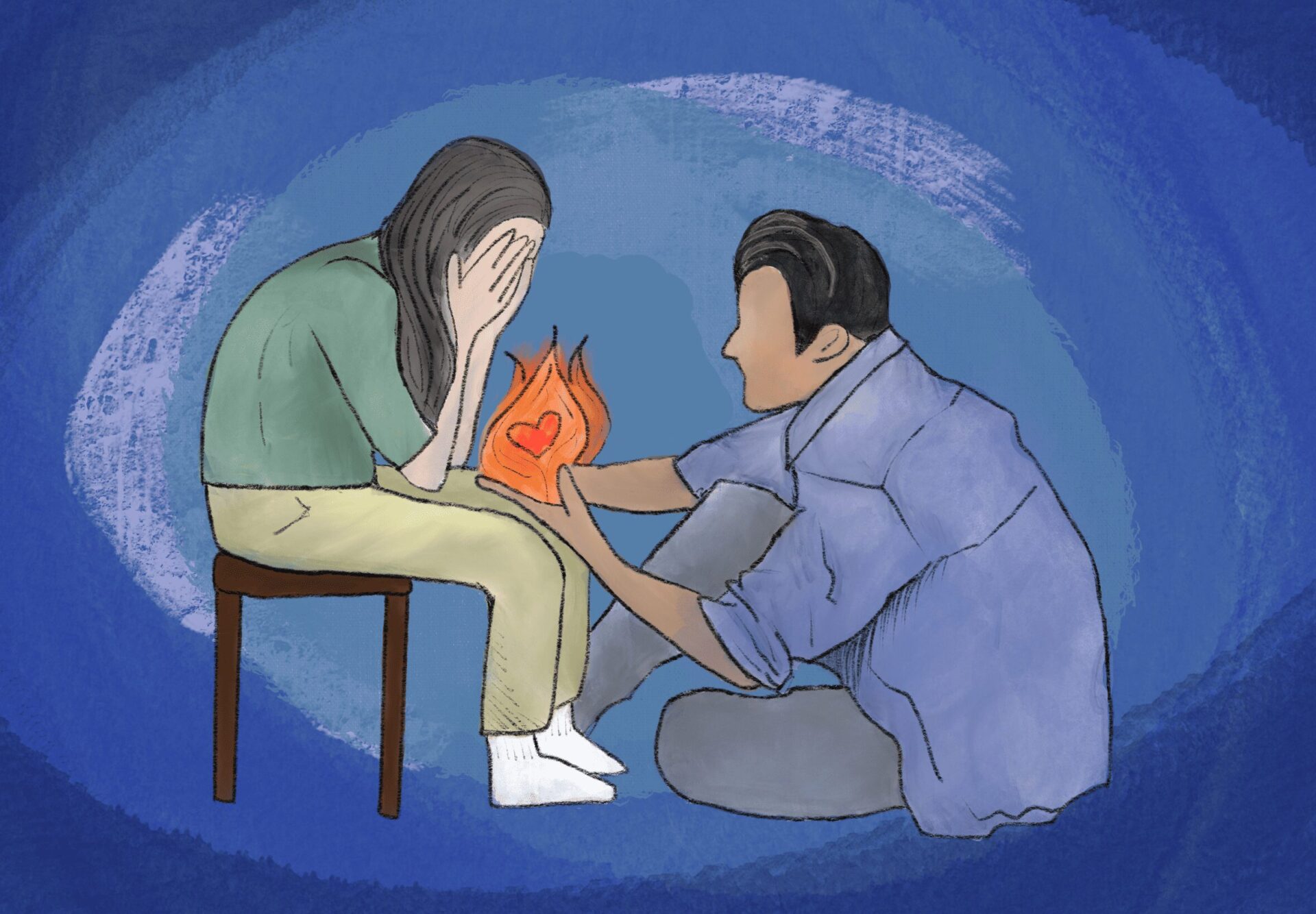
KG: There is something in the medical training system that always makes us doubt ourselves. We never know it all. We’re all very uneven, and we are all on a treadmill to try to gain more knowledge, to be better. And that can really lose the essence of why you went into medicine. You’re going to be learning forever. Don’t let the process squash the flame.
SN: Is there anything that you were hoping to get to say about spirit that you feel we didn’t cover?
KG: This was like a blessing to have this conversation. Like you ask about self-care, right? I’m doing this interview as a favor for you. And how does it end? It ends with me feeling great. It ends with me feeling the privilege of speaking to two doctors in training trying to explore these incredibly passionate issues. I am less tired now than when we began our interview. You gave me energy.
SN: I think few people speak on purpose in medicine more passionately and more convincingly than you do. So thank you so much for your time and your words.