By Jingyi Zhang, MS1
To whom, as whom, and in whose interest does [one] write?1
In his essay collection The Writer as Migrant, Ha Jin raises these three existential questions to all writers. He believes they are especially difficult for writers like himself, who are telling stories to an adopted audience in an adopted tongue.
Jin is a Chinese writer who moved to the United States in 1985 and writes in English, his second language. He puts himself into conversations with other diaspora writers—including Joseph Conrad, Vladimir Nabokov, and Milan Kundera—to examine the obligation they feel for their homeland, the challenge of writing in a non-native language, and their nostalgia for a home no longer there.
I came across this essay collection in my first semester of medical school. It was my fifth year in the United States and my first year in Philadelphia. It was a time when I turned away from careers in the humanities and mourned the lost opportunity to study medicine in China. It was also a time when I rediscovered my love for fiction and decided to give English writing a second try.
I wondered to whom, as whom, and in whose interest do I write. I also wondered to whom, as whom, and in whose interest do I study the arts of medicine.
***
Jin used to consider himself as “a Chinese writer who would write in English on behalf of the downtrodden Chinese.”2 However, he soon realized the complexity of such a position, especially after his Chinese readers accused him of appropriating their miseries for his personal gain in the United States. He later stopped writing about contemporary China to sever his misplaced obligation and focus on his craft. However, he still considers writing in English as “the ultimate betrayal” that “alienates him from his mother tongue.”3
The Tiananmen Square massacre was Jin’s reason for staying in the United States and eventually writing in English. He had to preserve the integrity of his work, even though the decision meant to forego the possibility of writing to his own people. I, however, cannot elevate my motivation to such a grand narrative. Unlike older Chinese immigrants who experienced political turmoil, I grew up sheltered from such oppression, and politics was at most a daily nuisance.
My motive for coming to the United States was perhaps a teenage girl’s romanticism about the unknown. After a middle school summer camp in Illinois, America planted its seeds within me with its big suburban houses, colorful hand sanitizers hooked on girls’ backpacks, and the sweet smell of air fresheners drifting through the hallways. After I returned to Beijing and plunged back into endless exam cramming, my young self dreamed of being in America again. My parents and teachers became my cheerleaders. Going to America, to them, was also a symbol of success. America was so baked into what we defined as the good and the beautiful that everything—from democracy to kitchen towels—had a sense of directionality: the closer it was to America, the better it must be. Unfortunately, I had rarely questioned what I would lose and who I would leave behind.
Similarly, my wish to write in English started out rather simple. Writing in English used to be a status symbol among me and my high school peers, as it meant being smart or attractive. Yet most of us barely finished our college application essays without sounding alien. After setting foot in the United States, I was made more acutely aware of my incompetence in playing this game without knowing all the rules, but the desire to write grew stronger. I did not want to remain a pretender, claiming to enjoy writing but never producing a legible work. My lack of consumption of Chinese literature further deprived me of the ability to juggle with my mother tongue. This “linguistic lag” from losing touch with one’s native language after being away from one’s homeland, as Jin describes, forced me to pick up new instruments.4
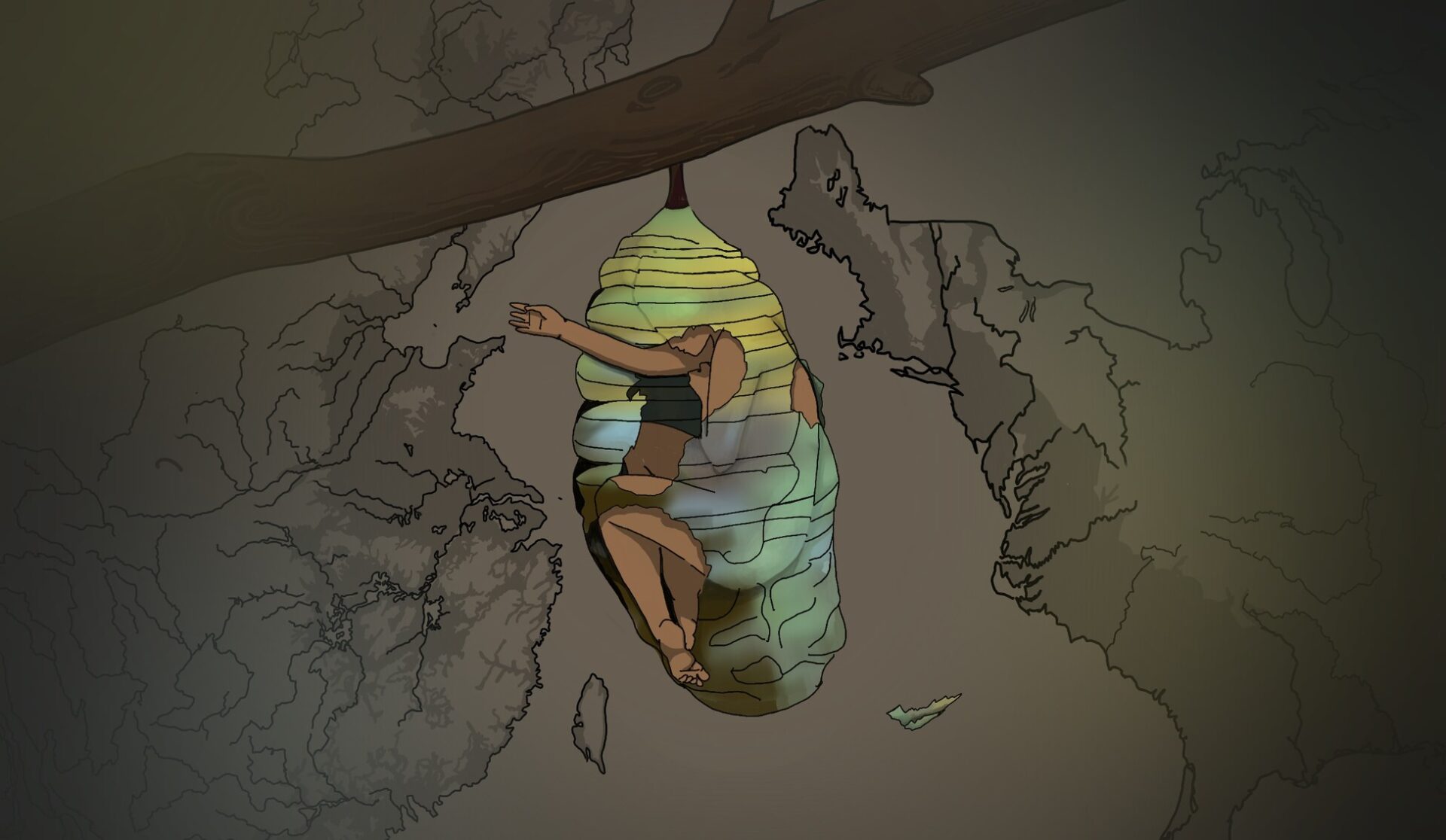
Yet writing in English is never easy. I still feel deeply insecure, and at times ashamed, about the words I put on paper. Writing used to be a catharsis, a way to defend my thoughts, affirm my identity, and rise above unfavorable circumstances. Yet it now feels like banging my head against a stone wall that never fractures. I am sealed up in a cocoon, unable to get my thoughts out, losing that intimate touch I used to share with the reality around me. I can barely find the ordinary phrases, not to mention coming up with anything extraordinary to describe the world or reach another’s heart. Though my education taught me to fit words into sentence structures like puzzle pieces, when can my mind paint a picture in its entirety without the artificial cracks in between? I often wonder, did my perceptions become less intricate—am I appreciating beauty to a lesser extent—after losing shelter from my mother tongue and never reaching dexterity in my second language? Is the bleakness of my language—and more alarmingly, the subsequent bleakness of my thoughts—something I will eventually overcome, or do I have to endure through a barren mind for the rest of my life?
Even Nabokov admits,
My complete switch from Russian prose to English prose was exceedingly painful—like learning anew to handle things after losing seven or eight fingers in an explosion.5
I imagine it is difficult for most migrants to pursue writing in their second language. Their stories remain unheard, their complexities remain unseen, and their existence is only narrated from their children’s or other spectators’ eyes.
I sometimes wonder if I chose medicine because I knew the limitations of my words, yet I still wished for human connection.
***
Studying medicine in a foreign country sometimes feels the same as writing in one’s second language. Medicine is a community-centered field. A doctor can only serve a specific set of people limited to a space and time, just like how a writer can only write to a specific audience given their choice of language. Second-language writers give up speaking directly to people in their homeland. They must hope for translators to bring them back home. As medical students, we give up serving people in our home country. What will bring us back home?
In my first semester of medical school, we were asked to spend an afternoon each week talking about our sense of place in Philadelphia and our roles here as future medical providers. As a new transplant, I had very few experiences to share. I kept wondering, as a five-year-old in this American society, what earned me a place to care for those living here.
In college, when I started volunteering in a hospice in New Hampshire, I spent months worrying about whether my poor English resulted in my poor service—only later did I realize that it was difficult for anyone to decipher the speech of the dying, and that did not hinder us from providing good care. But I still carry the irrational worry to this day. Can I completely understand my patient? What if I miss something important?
During those afternoons, I also realized I wished to talk about something else—I wanted to talk about healthcare in China. I wanted to understand why we don’t have a primary care system, why doctors cannot be better compensated, and why some patients would, once in a while, pick out a knife and stab it into their doctor’s flesh. In college, I was fascinated by the idea of advance care planning or shared decision-making, things I never heard of growing up. But I learned when I went home that in a country that lacked these legal infrastructure around consent, capacity, and the right to refuse life-sustaining treatment, few of the things I learned could be translated.
When I shared with my grandfather that I was accepted into medical school in the United States, he texted me sweetly, “Grandpa is especially happy, many congratulations!” When I saw him later that summer, he asked, “Does that mean you can help me ask your professors about my cancer?”—I regret nodding yes to his question.
I remember his gray pants no longer fit, draping from his bony legs. His skin, once pale, darkened and spotted by cancer drugs. The sparse hair on his eyebrow stood up, as if the wind had just gusted by.
Yet none of these sights brought me to fulfill my promise. Neither have I become a cancer expert, nor have I shown his CT scans to any doctors in America. Who can I even talk to? Isn’t it unprofessional? I can only place my trust in the care he already has in China, despite how fragmented it is sometimes. Yet I also ask myself, what’s more important, the very life of someone you love, or some mere social norms?
By choosing to study medicine in the United States, I forgo the possibility to see patients in my homeland. I will not be able to use connections to help my grandpa find better doctors in Beijing. I will not be able to care for my parents when they grow old, unless I force them to resettle in a foreign country. I will not be able to work alongside the amazing people I met at home to make changes in palliative care and medical decision-making.
When describing Nabokov, Jin wrote,
The tragedy is not that he might have written better in his mother tongue but that he had to give the prime years of his creative life to English, a language in which he never felt at home.6
Similarly, it is perhaps a tragedy to spend my prime years learning so many things to help my future patients, but few of them could be used to help those I love. In Jin’s words, studying medicine in the United States is a ‘betrayal.’ It is a betrayal against my family, my neighborhood, and the community that brought me sorrow and joy for the first eighteen years of my life.
***
During the pandemic, I did not return home for three years. I was close to my family and missed them deeply, but excuses kept coming one after another—tickets were expensive, quarantine was a hassle, I was busy… in my head, it was never the right time. My decision to delay my return tormented me but also motivated me. Beijing became such a distant utopia that I felt the need to earn my return as a reward for some achievement.
Fortunately, I got into medical school and went home the summer before I started. Unfortunately, only then did I realize that home was not the same. In Beijing, I had few friends of my age. I had grown into different habits from my family. I struggled to explain things in Chinese, the language that I thought I was the most comfortable in—the language that comforted me when I was away. Quality time with family was often spent in silence, each of us slouching in a bed or lounge chair, entertained by our separate digital fantasy.
I was sitting in the backseat of my dad’s car, nauseated by the cologne that we always used to cover up the mustiness from the fans. Along the ring road to my grandparents’ place, I looked out for modern skyscrapers and Soviet-style residences that reminded me of my time in this car as a kid. Yet the familiarity only brought me boredom and isolation, which I felt guilty for feeling.
In his final essay, “An Individual’s Homeland,” Jin wrote,
Nostalgia often deprives [migrants] of a sense of direction and prevents them from putting down roots anywhere. The present and the future have been impaired by their displacements, and their absence from their original countries gives them nothing but pain.7
Yet stories throughout literary history also revealed,
[Migrants’] returns are failures because they don’t have a homeland anymore. In their countrymen’s eyes, they are foreigners; for a long time, they did not exist to their countrymen at all, not until their sudden reappearance.8
Therefore, Jin argues that homeland should not be a fixed space; it never has to be one’s country of origin. Rather, it is “something the migrant should be able to build away from his native land.”9 In other words, rather than obsessing with return, Jin believes migrants should focus on arrival, or how they can create a sense of home at each of the new places along their journey.
I should stop indulging in the illusion that home is always elsewhere. Home is wherever I am. I cannot deny the immense love I received in my new homes—New Hampshire and Philadelphia—for which I am forever grateful.
***
Not everyone shares such an optimistic outlook for migrants’ place in their new homelands. Polish scholar Stanisław Baranczak once described the stranded position of migrant writers,
An outsider … can, through a lot of effort, finally attain fluency and glibness that make him sound almost like a native writer. But literature is something more than glib writing. It also includes the right – and necessity – to violate glibness, to make light of rules, to speak in a novel way without bothering to be correct … In order to say anything relevant, you must break a norm. And this is precisely what an outsider cannot afford … If a native writer purposefully violates language, it’s called progress; if an outsider does it, it’s called malapropism.10
In other words, Baranczak believes second language writers are afraid to make mistakes in their non-native language; therefore, they do not dare to break rules and innovate. Migrants in general are forever outsiders. They are, at their best, successful imposters.
Is this true? Do we have a way out?
It seems we can also easily argue for the exact opposite— second language writers are more likely to innovate, exactly because they break rules more easily in their non-native language.
Yiyun Li, the writer I adore the most, frequently mentioned that because English is her second language, she is not accustomed to the same habits in word choice. Many idioms and diction are unnatural to her, so she is motivated to trace their etymology in dictionaries and ruminate over their use. Compared to a native speaker, she is perhaps more likely to study these conventions, question these conventions, and resist using these conventions in her writing. For example, she once cleverly wrote,
“To kill time,” an English phrase that still chills me: time can be killed but only by frivolous matters and purposeless activities. No one thinks of suicide as a courageous endeavor to kill time.11
It seems breaking norms is exactly what an outsider is the best at.
Last year, I discovered Li’s work when I was trapped in the summer rains of rural New England without a car. It was my first time reading English language works by Chinese diaspora writers. It took me a few tries to overcome my doubt about her writing when flipping through Where Reasons End, as I didn’t expect she could assert such a powerful voice.
To me, literature used to be distant tales set in ancient times or foreign lands. It had rarely been stories happening right now, among people around me. I barely studied contemporary literature growing up, nevermind literature from a woman who migrated from China to the United States and wrote in her second language.
Li helped me see that Chinese stories and experiences can be beautifully preserved in another language; the beliefs that shaped how we think and act can be thoroughly examined in English. Quintessential experiences, like memorizing the three autobiographies of Maxim Gorky in middle school or writing propaganda in military training, are also stories worth telling. These used to be experiences I considered un-American and strived to unlearn. As I witness the setting of Li’s work pivot from China to America and recently to rural France, I further feel there is something universal to the human condition that transcends national borders.
I don’t know to whom, as whom, and in whose interest did Li intend to write. But I know her writing convinced me that I perhaps also deserve a place in this society. I wish that one day, I can also console other wandering souls through writing and medicine.
As I follow the path of medicine, I also hope that there is something more within a provider-patient relationship than in a writer-reader relationship. What connects us is not mere words on paper; rather, it is the moments of silence, the hug of support, the concerns from our eyes, or sometimes just our sheer presence as another human being.
I secretly wish these moments could transcend the vast differences in our past. They will put us hand-in-hand even when our language or shared experiences run dry.
References
- Ha Jin, The Writer as Migrant (Chicago: The University of Chicago Press, 2008), 3.
- Ibid., 3-4.
- Ibid., 31.
- Ibid., 79.
- Vladimir Nabokov, Strong Opinions (New York: McGraw-Hill, 1973), 54.
- Jin, The Writer as Migrant, 57.
- Ibid., 63.
- Ibid., 72.
- Ibid., 84.
- Stanislaw Baranczak, “Tongue-Tied Eloquence: Notes on Language, Exile, and Writing,” in Altogether Elsewhere: Writers on Exile, ed. Marc Robinson (Boston and London: Faber, 1994), 250–51.
- Yiyun Li, “To Speak Is to Blunder,” The New Yorker, 2 January 2017, 31-33.