Art by Kass Zhang, MS1
“Try Room 10.”
My time at Mount Carmel Hospice gave me some of my life’s most profound moments. My role was simple: sit with patients and listen. Some spoke freely, filling the space with stories. Others rested in silence as we held hands, saying everything without speaking. Whether through a conversation or quiet presence, those moments changed me.
Nurse Val always knew who might want some company. One cold November evening, he pointed me down the hall. “Try Room 10,” he said. “Mr. Finn might like a visitor.”
Mr. Finn was in his eighties, living with Parkinson’s. He sat with a blanket draped over his lap, wearing a faded crewneck probably brought from home with standard hospital pants. He had an even layer of short white hair on his head, his shoulders were slightly slouched, and his eyes showed signs of time, fatigue, and wisdom.
I knocked and stepped inside. He lifted up his head slowly to greet me, and as I said hello, he reached out to shake my hand. His hand trembled slightly on approach, but when our palms met, his grip was strong. “That’s a firm handshake, Mr. Finn,” I said. After introductions, he smiled and asked a question that would define our time together:
~
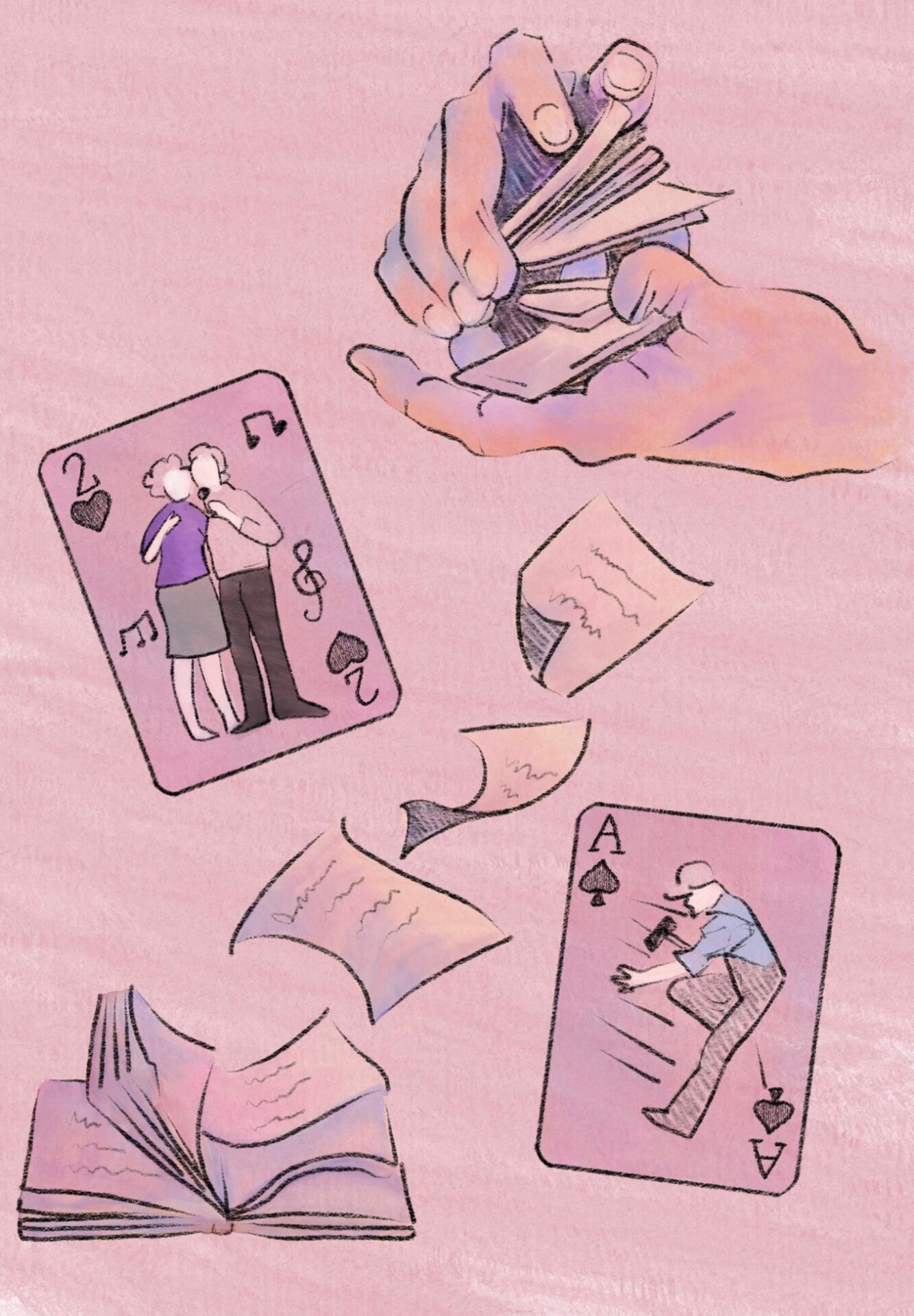
“Do you have a deck of cards?”
To his delight, I did indeed have a deck in my backpack. However, to his dismay, I had never learned to play gin rummy. I had been hoping to use the cards for something simpler—maybe Go Fish, or War.
That evening, he taught me the rules and we played. I lost miserably, not just that night, but week after week. Mr. Finn was always focused, and I swore that his hands slowed as he moved the cards about. His tremors did not disappear, but they at least mattered less. He’d lean over, a determined look on his face, and carefully select his next card. Before each game, I’d brace myself for his inevitable mantra: “You’re gonna get beat.” He was always right.
~
“You should’ve seen me sing.”
And so, our ritual began: a handshake at hello, another at goodbye, and gin rummy and stories in between.
The stories came slowly at first. He spoke of his years as a handyman, of calloused hands and proud creations. But mostly, he spoke about his memories with Cheryl, his late wife. Even as his voice tired, his eyes gleamed when he talked about her. They used to sing karaoke together, mostly old rock. Their voices would mix everywhere: in the kitchen and at karaoke bars and family gatherings alike.
“You should’ve seen me sing,” he said one night, his eyes speaking a thousand words. I could almost hear it, their voices echoing through time.
“I believe it, Mr. Finn,” I said. “I can tell from your voice.”
He asked me about my life, too. I told him about my siblings, my parents, my dreams. We traded stories like we traded cards in gin rummy (although, I was better at stories, and Mr. Finn was good at both).
~
“You’ve been a real friend to me.”
Over the course of six weeks, our twice-weekly visits became routine. What started as formal volunteering became a familiar part of my schedule. Silence no longer needed to be filled, as it often feels with good friendship.
One evening, Mr. Finn was a little more tired than usual. He looked at me, and said, “You’ve been a real friend to me.”
My heart ached, and I knew. Yet, I reminded him that, as always, that I’d see him in a few days.
~
“You’ll never beat me.”
The following Saturday, I stepped into room 10 and found it empty.
We had spoken about his departure, but it only became real to me at that moment.
I stood there for a moment, then turned with a wistful smile, tucking the deck of cards back into my pocket.
Mr. Finn had been right all along: I’d never beat him at gin rummy.
~
I think about Mr. Finn often. He taught me that presence is not about fixing a problem, but just about being. Not listening for answers or solutions, but looking for space. Asking questions that invite the flow of stories, emotions, and connection.
In the years since Mr. Finn, I’ve found myself listening more intentionally and actively, both in the clinic and in my daily conversations. Whether in our daily lives or at the end of life, connection is so, so valuable. It matters.
I think that’s why I wanted to become a doctor in the first place.